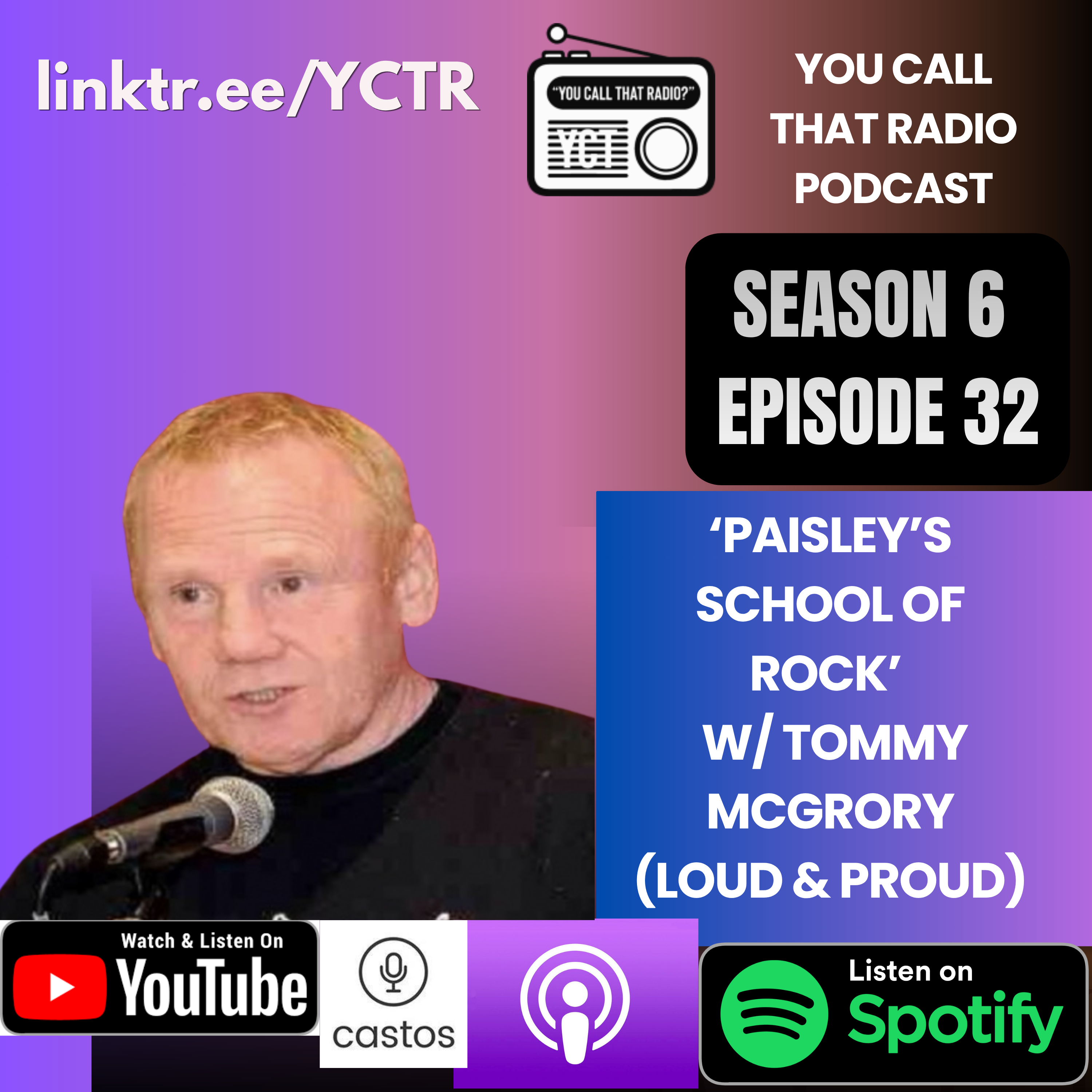
[00:00:00] Speaker A: We went to Paisley and we were there for a secret project. I can't tell you about that the now, but while we're there, we had a surprise conversation with Tommy McGrory of Loud and Proud School of Rock in Paisley.
Three years ago it was the victim of an arson attack and this building was nearly burnt to the ground and now it has risen from the ashes and is thriving.
It offers tuition rooms, teach people how to play, teach people how to write, teach people how to perform. There's recording suites there, rehearsal rooms, tradition rooms, and there's also a podcast room for social media content and stuff. A really interesting conversation. Hope you enjoy it.
[00:00:50] Speaker B: I'm Tommy McGrory, I'm the founder of Loud and Proud. We're in Paisley and we've been doing rock and roll for 25 years now.
[00:00:59] Speaker C: 25 years.
[00:01:00] Speaker A: And we've just wandered around this facility.
We're here for the.
They've loved the experience and we just get taken around. There's so many rooms. Could you just explain to people what. What's going here?
[00:01:15] Speaker B: Started 25 years ago in Paisley and we've been everywhere. We've been in an old Liver Club, an old garage, been up in a place in Rentrue, place in the high street.
But each and every time there's a problem with the building, either the roof's falling in or we've run out of money to pay for it. So we moved about a lot and then we finally found a wee place where we are now. It's a wee part of the building. We built a studio. Then Covid came and that flattened us. We ended up with no money and we got back up and running just after Covid and then somebody set fright of the building and then we sat about and our thumbs up. We didn't know what to do because the place was a complete mess. One part of the building was completely destroyed and the rest was all black smoke damage and the carpets, everything was filthy and it looked as if we were going to be out of business, basically.
And the guy that owned the building came at the last minute, he said, I'm going to give you the building. So he gives the building, which is great. The bad bit was that he did a lot of work. So just it's been burnt, it's been bundle. It was. It was a. As a arsonist that done it. So it wasn't like electrical fire that somebody done it. So the good. The good part is that the bad part was somebody set by the own. The good part is we now want it. Because Gary Kerr, the guy who built the business in here, has. Has given us the building. So it's taken us three years to get to where we are now. And it is impressive, but it's been a long three years.
[00:02:44] Speaker C: Absolutely.
What can we talk about the different rooms? So we've got the. You've got your rehearsal rooms, you've got recording rooms, tuition rooms.
I've seen a social media room as well, for what is set up next to. For podcasts.
How. So it's taken three years.
What did you. Is this how you imagined it?
[00:03:07] Speaker B: Kind of.
[00:03:09] Speaker C: Because you're talking about stuff coming down with the idea in your head, the plan.
Is it kind of coming to fruition? Yeah.
[00:03:19] Speaker B: The core of what we do is teach you how to play, put you in a band, get you on a stage.
So it's learn, create, perform those three things and just keep it simple. And within that context, there is other stuff that goes on. Yeah, there's songwriting, there's recording.
But then because of the building the way it is now, and we are so lucky to have a facility like this, our emphasis now is in songwriting and new work, you know, so we're doing a lot of songwriting courses, teaching young people to think about. Right. Because if you don't. If you don't get somebody to write a song, they never. They'll never know whether they can do it. You know what I mean? And I know there's a lot of barriers because a lot of dumb people, oh, I couldn't write a song, nobody'll like it, I'll be rubbish. And. But you. We encourage them to just go ahead and write songs so that. So it's became.
What we're trying to do is become. Become a songwriting creative place rather than. It's not a rehearsal studio. We've got rehearsal studios for rehearsing stuff. But it's not like Bentley. It's all education. It's got to be education. It's not a place to practice Highway Hell all day in the band. It's got to be more creative than that.
There is a place with Highway Health, which is one of my favorites.
But never mind.
It's all about creating stuff through learning and performance and on the way, that performing thing, learning what to do when you're on stage, and a wee bit of management advice. But none of this is in a PowerPoint. This is all rock and roll here. It's not done like we're going to have a class on music management or music law. It's all people that know stuff and we all talk at the. Having. Making coffee at the kitchen and it's a complete hub of, of expertise in the building and everybody's there to be asked questions. We're so lucky. We've got three music producers. We've got Ross Hamilton who's done some great work. My son Jamie, great producer. And Brian McNeil who's worked in all the top studios in Scotland and abroad.
All great music producers feel everyone else, they're just normal guys and they're there to answer young people's questions rather than, as I say, get a PowerPoint presentation. Because most musicians couldn't sit through a PowerPoint presentation.
[00:05:51] Speaker C: I didn't do very well with it.
[00:05:53] Speaker B: It just went going to give an answer to that. There's pro tools. Isn't it working what they are doing? And that's it done.
[00:05:59] Speaker C: And also the problem with PowerPoint presentations is that in this modern era, the time you. The time the print's dried, it's a date. So I know that there's a lot of things that are getting taught sometimes in university colleges that's been written three years before or something.
[00:06:15] Speaker B: Yeah.
[00:06:15] Speaker C: And things are moving very fast. So by being surrounded by actual active producers and musicians. I've seen the. I didn't get his name, the drummer guy yet. I've seen. Yeah, I think he's a drummer.
[00:06:26] Speaker B: Connor.
[00:06:27] Speaker C: Connor, yeah. So I've actually been surrounded by people are active musicians and they're still, they're still doing it.
[00:06:33] Speaker B: It's a great story about Connor.
[00:06:35] Speaker C: He.
[00:06:35] Speaker B: As a young boy there was an event happening in Paisley Cross and it was called Paisley is Great. That was the thing, the youth thing. And they were encouraged to chalk some stuff on Paisley Cross on the, on the pavement, which, which I used to get kicked in the ass for doing that. That's what they were doing.
He. I've got a great photograph of him. He's bent down and he's written by a big butt of chalk. When I grow up, I want to play drums for a living.
Now he was only 13 year old at the time.
[00:07:08] Speaker C: Yeah.
[00:07:09] Speaker B: And that's. And he's done it.
[00:07:10] Speaker C: Yeah.
[00:07:10] Speaker B: And that's the kind of place this is. You know, we, we.
The percentage of part time, full time professionals in the industry, it's very high here and it's, it's a lot to do with inspiration and being able to talk to people for advice and the teaching is important as well. You need to play right, you need to be taught right. And. And it's not like school, it's not as Pure old school, if you know what I mean. And it's been working for 25 years and I'm hoping the next 25 years makes us bigger and better.
[00:07:44] Speaker C: Yeah, it's. It's a really good point you made there as well. Because when you talk, it's the people that are speaking to the young people, they're learning as well. Because there's something, someone coming with a fresh perspective and asking a question, you're like, oh, I've never really thought of that before, or you get to respond and, and you realize what your answer is. And it's always interesting. I think that, you know, going back to what you said about the people saying, oh, I'll be rubbish, they don't want to write their own songs.
[00:08:14] Speaker B: Yeah.
[00:08:14] Speaker C: And obviously for me, I, I, you know, from a scheme. So originally I wrote my lyrics secretly and I didn't tell anyone because, you know, from Smallton nurser Liam Gallagher, rock no star. You'd get, you know, it would have been. So I was, I was self conscious about it and, and now when I see other people going through that, it's just like, just there, just there. And it always. I'm always blown away by somebody who's just made the first ever song or poem. It's just something about it just can sometimes just get an amazing lyric.
[00:08:49] Speaker B: Sometimes when you put it in perspective for a young boy or girl that's TR to write for the first time and, and they're struggling and they, they've not got much self confidence. They've not got confidence at all. Right. You're trying, you try to encourage them and it's. I try to explain to them that it's like everything else, you need to practice.
So you're practicing. Isn't that one song you're practicing? Songwriting is writing 100 songs.
[00:09:16] Speaker C: Yeah.
[00:09:16] Speaker B: And out of the hundred songs, you might actually have one in there that's this song. Yeah, but you need to get to the hundred. Don't write your first song and it might sound rubbish and then feel deflated because some of your mates or somebody doesn't like it or it doesn't work. Just keep going to get that hundred and then you get. Might get one. Because it's a learning process. It's not like, yeah, write a song. So they write a song, it's rubbish. Then they go, right, I'm never doing that again.
[00:09:43] Speaker A: I've got a friend that did that.
[00:09:45] Speaker C: He played the song. He used to just play about Pink Floyd and Oasis at the house parties or whatever. You know, we're still young boys at the time.
[00:09:52] Speaker B: And he would.
[00:09:53] Speaker C: Everyone would like him sing along. Then he went, you know, he brought his song to the.
The group.
And the group was just. I think that was Play Wonderwall. I think it was genuinely play. Play Wonder Ball. And I was like, you know, I tried to. I could see that he was. He was gutted. So I tried to give him some support.
But, yeah, I think he just stopped playing.
[00:10:15] Speaker A: I know.
[00:10:15] Speaker B: And he. And here's. And here's the.
And here's what happens. That guy did me. He didn't do it again.
[00:10:23] Speaker C: No, I don't think so.
[00:10:23] Speaker B: But see, if you go over that.
[00:10:25] Speaker C: Yeah.
[00:10:25] Speaker B: And he went away and he done about 40, 50 tunes.
[00:10:27] Speaker C: Yeah.
[00:10:28] Speaker B: And learned a wee bit more. Because you can't expect to drive a car in your first lesson.
[00:10:33] Speaker C: Absolutely.
[00:10:33] Speaker B: You can't. You can't write a song in your first effort at writing a song. And we try to explain that so that, you know. Yes. And some people won't like it. You know. You know, it's. It's kind of easy to teach people to play guitar and play drums. Yes. Easy about. Because I just mimicking and copying.
[00:10:53] Speaker A: So you do it. You deal with them.
[00:10:54] Speaker C: Do covers at the beginning just to get them in. Is that. Is that.
[00:10:56] Speaker B: We do that.
[00:10:57] Speaker C: That's obviously. That's a good way somebody wants to pick up so they can play their favorite song.
[00:11:03] Speaker B: If you guys. Two guitars are bassist or drummer that never met each other.
And then the room for the first day for three hours, you would say what. What kind of songs you like? And if they put their hand up and say Wonder Wall, you know, Here we go again.
[00:11:17] Speaker A: Vocal booth, Vocal booth.
[00:11:19] Speaker B: Top notch.
Oh, wow.
[00:11:22] Speaker C: Spacious.
[00:11:24] Speaker A: I've been in a lot of vocal booths. I'm usually in a cupboard or what feels like a cupboard.
[00:11:30] Speaker B: Honestly. It's usually Highway Hell. It's Highway Helmet one still the one.
So if they all know how. Right. Okay. They've got handle on it. And after the three hours they play the tune in a band.
[00:11:42] Speaker C: Yeah.
[00:11:42] Speaker B: And then they enjoy it. And then they come back from law.
[00:11:46] Speaker C: And what. What is the. The music taste? Because every. I'm a little bit of the young folk visit. It seems to me that when. When it does come up, they seem to sort of still reveal the. The classic artists, you know, like, you know, I hear that, you know, but it's like bands like Stone Roses, Oasis, Arctic Monkeys or.
I think that's.
[00:12:06] Speaker B: I think even today, I would say most young guitarists that come in and we ask them what they like.
It's still 70s rock a lot. You know, it's all. It's still. You have AC DC one one we guy. We call him Johnny Cash because he came in for his guitar lesson and we said, what? Who do you like? He said, johnny Cash.
[00:12:29] Speaker C: Yeah.
[00:12:29] Speaker B: So it's coming from their parents, maybe.
[00:12:31] Speaker C: Yeah.
[00:12:32] Speaker B: But We've got another we guys. He's now 10. He joined us when he was nine.
[00:12:36] Speaker C: Yeah.
[00:12:37] Speaker B: And he came in, said to the drum teacher, can you teach me a. A tune from Tool?
[00:12:44] Speaker C: So.
[00:12:45] Speaker B: And it just so happens that Connor, the drum teacher, he's a massive Tool fan, but.
[00:12:48] Speaker C: Oh, right. He was going to see me strummers ago.
[00:12:50] Speaker B: That didn't come from his mom and dad. I know his mum and dad, they're not any art music at all. But wait, he's on YouTube and it's quite refreshing, actually. You're going to YouTube and you've watched hundreds of songs, probably.
[00:13:01] Speaker C: Yeah.
[00:13:02] Speaker B: And he stopped at that one and he said, I like the sound of that. I want to play that. So then he came in after he managed to play the Tool.
[00:13:09] Speaker C: It's a difficult. For anyone that doesn't know Tool is not easy.
[00:13:13] Speaker B: It's Prog Rocket.
[00:13:14] Speaker C: It's not.
[00:13:15] Speaker A: And then
[00:13:17] Speaker B: the next. And I was going to say the next tune was a bit easier, but I don't think so. It's a Rush tune.
[00:13:22] Speaker C: Yeah.
[00:13:22] Speaker B: I can't remember Spirit of the Radio, but it came in. I like Rush. Yeah. But I know that's coming from him.
Yeah. You know, and. And most of the guitar students, definitely. Seventies and eighties, maybe, you know, Sweet Child of Mine and all that, and not many of them.
And maybe it's just us. I'm not saying this is something in the country. Yeah. No, absolutely not. Many of them in here are. Want to play songs by Edition.
[00:13:49] Speaker C: Yeah.
[00:13:49] Speaker B: Do you know what I mean? It's all classic.
[00:13:52] Speaker C: Yeah.
[00:13:53] Speaker B: Let's like say that they'll stick to classic rock. I've had students in here and they've started off with Highway Hill and Sweet Child of Mine and John J done all that. And as they got to about 16, 17, some went to uni, some went to college and they took a jazz route. One of the guys that started off with a guitar, a big V guitar with two rockets coming out, the boy's guitar, they had long hair.
And now he plays in the jazz bar in Edinburgh. Yeah. You know, because I was playing the guitar.
[00:14:27] Speaker C: I mean, Glasgow and Edinburgh have got some really healthy jazz scenes just now.
[00:14:30] Speaker B: Yeah.
[00:14:30] Speaker C: So post lockdown, it really kind of exploded.
So I. So, so you said so just sort of to wrap up because I know that's a man. But what's the. How can people get involved or how can they help or.
And then what's the plans for the future?
[00:14:49] Speaker B: If anyone wants to come and see the studio, contact us through the contact page on www.loudandproud.org. if you Google Loud and Proud. There's not a lot of rock and roll places called Loud and Proud. Yeah, you'll find us.
There's a contact form on there. Fill it in. Tell us what you want, please, what you want to do. Press a button and we'll. We'll get back to you.
So if you want. You want a tour round, you want a lesson, you want rehearsals, you want to do sound production, Just tell us what you want to do and we'll figure out something for you.
[00:15:23] Speaker C: Amazing. And is.
And three said getting bigger and bigger because I mean this is. This is incredible. So I was hoping you're going to say, yeah, obviously he can't make something less and not be ambitious and thinking about the next thing because it looks like it's. It looks like I'm walking into a finished piece of art with the new paint smell and all the facilities here. But you need to just keep building, I think.
[00:15:48] Speaker B: Well, we need to get bums and seats now. You know, we worked really hard over the past few years, especially 2025. We're in here most days a lot. I mean, I'm a volunteer really.
I don't get paid for doing any of this.
And other people volunteered the time. We paid builders because we needed somebody actually knew what they were doing.
But last year was really hard. We were in every day, you know, pulling walls down and stuff. So we got there, we were open in January and things are trickling in a wee bit. But we could have. It could be a lot busier because owning a building means it's your gas bill and your insurance and all the bills are still there.
So.
[00:16:28] Speaker C: So how's that? Would that be? What if some. So how. How can people help? Would that be like you. What would. What is the main sort of problem there with more bands rehearsing or I
[00:16:41] Speaker B: think or more bands recording or what would all that. I think the three things, three big things that we do maybe slightly for is we teach how to play. So we need more students. Guitar based, strong vocals and keys.
[00:16:53] Speaker C: Yeah.
[00:16:54] Speaker B: We need young bands hopefully that do their own stuff.
That's a priority to get them in the studio to help them Find gigs, help them with their tunes and just be here for them. Yeah. And then record them as well. And anybody else that wants to call them. Good. Two brown recording suites in here. Yeah. Good in house engineers.
It's quite amazing. Yeah. And also we've got a podcast suite as well. So we're moving slightly into social media stroke film work and that's something we like to expand on. But at the moment it's a three core things. Teach you how to play, get in a band, perform.
[00:17:31] Speaker C: Yeah. And once they can perform, then they can go into the social media suite and.
[00:17:35] Speaker A: And make some content.
[00:17:36] Speaker C: Once you can learn to play a song. And that's brilliant, mate. Well, thank you very much for your time.
[00:17:40] Speaker B: Appreciate it.
[00:17:50] Speaker A: As I said at the beginning of the show that I was. It was a surprise. He didn't know I was going to be there. I didn't know he was going to be there. I had never been to the Loud and Proud school of rock before, so it was just a quick chat. I thought let's just, let's just put it in the audio podcast platforms as well.
And unusually short for us.
But that's better than nothing. We will be doing a full episode on Wednesday. Wednesday I will be speaking live with Joe D. Arc of the Twist. Its Minerva wakes Gyro babies Declan Welch in the decadent west and she drew the gun as she has some announcements to make and will be performing on October 30th for you call that radio's Halloween party, which also doubles up as the Apocalypse Theorist album launch.
And Jack O Trades will be performing and Texture will be performing who a.k.a. bram E. Gibbon. So it should be a good night. Tickets are on schedule. If you're a
[email protected] youcallthatradio Then you should have received a discount code as well. I hope to see you all there.
And before that we have the Merrill Folk album launch.
Merrill Folk launching their debut album Understory at the Rumshack October 24th.
And we call that Radio's taking over the after party with the exceptional legend that is more famous and the fantastic Jigsaw Tiger. They'll both be DJing till about I think. I think we're DJing to 1am, 1am at the Rumshack. So I'll hopefully see you there on the 24th.
And you call that Radio's also doing double bill on Ella Butte, going back to Bute on 17 October with Rebecca Radical and the Folk Drama performing.
It's a free entry gig at the anchor. So that's so it's Beaut on the 17th Rebecca Rather Going the Folk Drama 24th Merrill Folk Album launch. You call that radio after party at the Rumshack. And then on the 30th it is the Halloween party.
So yeah, hopefully see it one of them and then we'll go back to Beauty again for a tower. The stock broker Callum Baird and I'll be doing I'll be hosting and doing a wee spoken word set that at the Craig Moore Bowen Club in Rossi.
So yeah, four, four big shows coming up. Hopefully you can make them.
And once again, thank you to the patrons for making all of these things possible.
If you would like to support the channel, the podcast, the events, the things we do, then you can go to patreon.com forward/ucallthatradio.
Thank you very much for listening. The next episode will be Joe the Ark tuning live on the 14th of October on YouTube and we will make it available as an audio podcast shortly after that. I hope you are all very well and I will see you soon. Bye.
You are tuned into YCT.