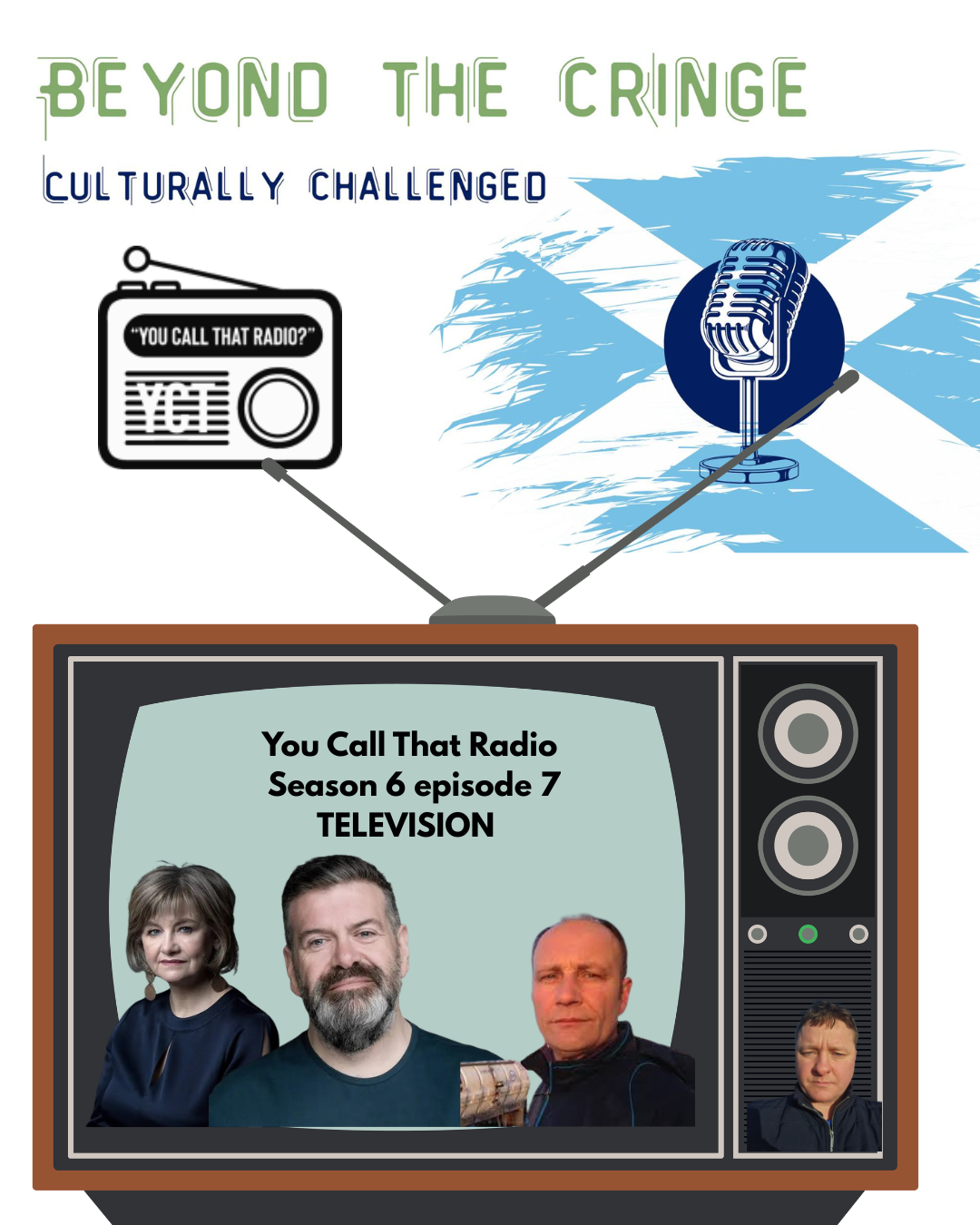
[00:00:03] Speaker A: Beyond the Cringe on. You call that radio?
The Scottish cultural panel show.
Today's episode is about television with Andrea Gibb, Tom Urey and your host, Jim Monaghan.
[00:00:26] Speaker B: So we're welcome to episode four of beyond the Cringe. Beyond the Cringe, a podcast where we look at Scottish culture in its widest sense all the way through for the fitba to the politics and everything in between. We look at things subject by subject in a cynical but not disparaging way. We look at our own culture, what it is, is it any good?
Do we need it?
Is it shite?
Or is it of any point or any worth at all?
And what we do is we get guests here together to talk about Scottish culture. And today we are talking about the telly, Scottish television.
With us in the studio was as our producer Mark McGee's running a wee bit late. He'll be joining in as we go along, Richard from GLAAD radio. And our guest today, the wonderful all rounder singer, comedy actor and all around good egg, Tom Ury. And with a screenwriter, director, producer and bit of a star these days with Ms. Austin and all that, Andrea Gibb.
[00:01:34] Speaker C: Hello. Hello.
[00:01:35] Speaker D: Hello. You said all round twice, so that's fine.
[00:01:39] Speaker B: You're an all rounder twice.
[00:01:40] Speaker D: I know, I know.
[00:01:41] Speaker B: A big all round, all round good egg.
[00:01:44] Speaker D: Did I say that round person.
[00:01:45] Speaker B: There we are.
So Scottish telly, Tom, I'll start with yourself.
If you hear the phrase Scottish telly, what does it make you think of? What image does it conjure up?
[00:01:58] Speaker D: Well, because when I was a kid, Scottish telly was Andy Stewart and thingmajig and stuff like that. That's the kind of. It's almost like the cringe factor. For me, when people mentioned Scottish telly, it was before things got gritty, I think, but then you got all the kind of Peter McDougall stuff and everything that came along in the 80s and then it kind of hardened up a little bit. So I now think I've Scottish telly as and it's current format. I love the documentaries that are coming out BBC Scotland just now. The true crime stuff. I think the world beaten.
And also, you know, I think people love or hate the comedy that comes out because there's been some absolute classic comedy made in Scotland as well.
[00:02:41] Speaker B: I think sometimes the comedy unit at the BBC obviously done some incredible work over the years, but sometimes I think that's the cringe. But sometimes our comedy is just maybe. Is it maybe just a wee bit too Scottish?
[00:02:57] Speaker D: I don't know. I think people. I think Scottish People can be a little bit self conscious of hearing their own accent in the telly. I know I do sometimes if somebody Scottish turns up. Nice enders. I go, oh, no, why are you talking like that?
I think there is a little bit of that, but I think with every, with every genre, you know, you get. You get hits and misses.
[00:03:16] Speaker C: Yeah, I think that's really true. And I think as well, one of the things I feel about Scottish telly, if we could call it that, is that it is a very broad church. And I think that that's what's really important about how we represent ourselves on television, which is why it's really important that Scottish voices tell Scottish stories and all of that. But it's. But it shouldn't just be parochial. You know, sometimes I feel we get a wee bit inward looking and we don't look out enough and things like that. And I think it's difficult with audiences. Right. Cause when you're making telly, what you've got to think about is who is this for as much as what is it about? Or what are we saying? Or what are we saying about ourselves or our country, if you like. And I think there are pockets of audiences in Scotland that actually love that Scottish comedy. I mean, you think about Hugman A. Right. And the stuff that was on, it might not be to everybody's taste, to be fair, but there are pockets of audiences who absolutely lap it up.
[00:04:18] Speaker D: You know, there was one guy that was great at Hogmanay.
[00:04:22] Speaker B: Yes, absolutely. Yeah.
[00:04:23] Speaker C: Well done.
[00:04:24] Speaker D: Thanks very much.
[00:04:26] Speaker B: Yeah, but you mean.
[00:04:27] Speaker D: I think that in the past, it's getting better now. I think in the past there was a lot of.
A lot of focus on making ourselves understood in case anybody from not Scotland was watching. So there were a lot of people who used to speak like this on Scottish television.
There still sometimes is.
[00:04:46] Speaker B: There still is very much the Scottish thing.
[00:04:49] Speaker C: That's an interesting thing you bring up about accents because unlike the Irish, right, who have this, there's a romanticism about being Irish or whatever. Sometimes I think because we fall in, we've got a terrible tendency to stereotype who we are, particularly if we come from the west of Scotland or, you know, Scotland is either outlander or druggies in terms of the cliche stereotypes that we have. When we made Dear Frankie back in 2004 or something like that, it was made, it's a feature film that was made to travel right beyond Scotland and the Americans.
When we did the trailer, the Americans changed the voiceover to an Irish voice because we always get this thing when we're making Scottish telly. Ah, the accents, the accents, the accents. Can you pull your accent back? Can you. Can you. Can you hit your consonants? Can you just make it less Scottish in some ways? And I think our accents.
We have amazing accents across Scotland, you know, a diversity of wonderful voices. But there's something about that, about the way we are perceived in terms of our accent that I think is really prohibitive to us. In working in Scottish telly, I had
[00:06:03] Speaker D: to redub a thing. I'm not gonna say what it was. Cause I had done this thing and had to redub it for the American market.
And I went into the dubbing studio and I had a producer from Scotland in one year and somebody in Los Angeles from America in the other year saying how they wanted it said. And I had the American producer phonetically telling me how to speak. And the Scottish producer in the other year going, just ignore her.
You can't do that.
It was like really weird vowels and consonants.
They were creating an accent that just does not exist anywhere in the world.
[00:06:41] Speaker C: Yeah.
[00:06:41] Speaker B: I think apart from maybe Scotty and Star Trek, maybe the Irish guy.
[00:06:44] Speaker D: It wasn't even as good as that. It was like. It was like. Yeah, yeah.
The best I can describe it is speaking like Jim Kerry, but that kind of slowing it right down so that. It's a bit like that, you know,
[00:06:58] Speaker B: Barbara Dixon, like Kevin Bridges.
[00:07:01] Speaker D: He does that. Does he?
[00:07:02] Speaker B: He talks so slow. Everything's like three syllables over there. Yeah, yeah.
[00:07:07] Speaker C: I mean, there's pressure on Scottish artists or Scottish actors or whatever to make themselves understood, you know, for, like. You're talking about for. For producers or for the American market or for the outside world. Whereas a lot of other countries don't have that. Don't. They're not given that kind of pressure. I don't know what it is about our accent.
[00:07:28] Speaker B: I think we speak very quickly. That's something that. When I left school, my first job was in a travel agency.
And I was taught very, very soon to speak on the phone. Extremely slow, slowly, to the point I felt really uncomfortable. But it was the only way that. I think we sometimes don't realize how fast we're going, how fast, how fast we're going. And what I thought sounded like it made me sound. I felt like an idiot that we all speaking on the phone. But to some, in English, on the other side of the phone. Yeah, it was that.
[00:07:59] Speaker D: Just subconsciously, though, if I'm anywhere, if I'm in London, I'll slow down or I'll even Go full on London.
Do you feel, do you feel our
[00:08:08] Speaker B: responsibility as an actor, as a executive producer, whatever. Do you feel there's a responsibility that when you're portraying Scotland on television that you feel a bit. Is there a guilt there where you're thinking, I better do this right for the Scottish people?
[00:08:25] Speaker D: I've always felt that. I've always felt that. I really, really want this to sound authentic because I can't stand all that, what are you talking about? Stuff. I can't do it. But in the same, in the same breath, I've got to realize that we're creating something for people to be able to understand what you're talking about.
So I think it's just about people tuning their ears to it. And I think the more it's done, the more people actually are authentic in the way they speak. A great example just now is Ashley Stories show dinosaur. She's not making any apologies about her accent and it's going full on Scottish and it's plain in America and it's working. It's fine.
People might have to put the subtitles on for 5, 10 minutes, but I have to do that with other accents sometimes. But I think it comes from a place of personal cringe that we've all got about, oh, no, somebody's gonna take the mickey at me.
[00:09:14] Speaker C: I think it's about, it's interesting because I was talking about this to an Irish pal recently and thinking about the difference between Ireland and Scotland, right. Which, you know, the way the Irish treat their artists or treat culture or revere. I mean, my pal said if, if Seamus Heaney, you know, if they had a Mount Rush Rushmore, they would put Seamus Heaney on it. Right. And that kind of made sense to me. I thought, yeah, they, they, they, they're not embarrassed. They have a confidence, they have a, A belief in themselves, which sometimes we don't have.
And I think it's tough.
Our sort of conflicting national, whatever, I can't even think of the word that we're sort of. We're a nation, we're a country, but we're also a region. We're a region. And I think that conflict really, it goes against us in terms of when we produce our art or our telly, if you like, because we don't have that belief and that confidence in the way that the Irish do.
[00:10:19] Speaker B: So that's self consciousness that we have all the time about.
Is it about that we feel.
Is it about being this small country but being attached to England?
[00:10:29] Speaker C: Yeah. Being a colony in some ways. And the fact is that we are beholden in a way to finance coming. Like, in terms of. If you think about how we make our telly up here, we don't have full commissioning power.
So, you know, we've got people, commissioners working in our. In both, in both our STV and BBC or whatever, they can commission scripts or you can take books to them and they can go, that's a fantastic idea. And, yeah, we really need to do this. But then the final, the final, final decision is going to be made in London, not up here. And I think that's fundamental to how we are perceived on television.
[00:11:15] Speaker B: That's interesting. Is there a Scottish television industry or are we a regional industry of a uk?
[00:11:24] Speaker C: I think that's a really good question. And I would say it's complicated. I would say that we are considered to be a nation, but we are also treated like a region at times. And I think, you know, that the dominant culture, if that's how you want to put it, is English.
[00:11:45] Speaker B: Yeah.
[00:11:46] Speaker C: And therefore we are constantly punching. I mean, I think we punch above our weight here. I think. I think our talent and our skill set is incredible. Cruise actors, all of that, but our actors, you know, you think about people who are making our movies, like David Mackenzie or, I don't know, loads of amazing Lynne Ramsey, amazingly talented directors, but most of them leave in order to make their work because they can't get the finance or, you know, the support or whatever because we don't have enough infrastructure, we don't have enough money. So independent Scottish production companies are really struggling every. To get the next thing away and the next thing away because we don't have.
We don't have a cultural infrastructure here for the telly, if you like.
[00:12:37] Speaker B: So do we have.
Is there. Is there such a thing as a Scottish production or is all of it relying on getting a sort of UK wide backing?
What would you say if something was a Scottish. What would you call a Scottish production? Is it something that's made by a Scottish company, that it's made here in Scotland, or.
[00:12:56] Speaker C: I think it's. I think again, it's everything. It's all of that. Because if you think of what Tom just said about stuff that, you know, Peter McDougall in the past, in the 80s and wherever. Tutti Frutti, Crow Road.
I mean, when I first started writing, it felt like we were at the. We were in a golden age. You know, Peter Mullen was making his movies.
Everything there was schemes like Taunton Shorts and Prime Cuts and all of that TV and film were talking to one another. So TV films were getting made from the backing from, from Screen Scotland and the TV companies like SDV and whatever. Everybody was coming together with a kind of joined up thinking and then obviously that sort of dipped. We're in a bit of a downturn. I think that's absolutely.
[00:13:44] Speaker B: Does that take dominant personalities to make that happen? So for instance, when you say about that era when those things were happening, you had people like Paddy Higson.
[00:13:53] Speaker C: Yeah. And Bill Bryden, John Byrne, all of those people.
In many ways what's happened is the way that things are commissioned and made has shifted and changed because I think BBC Scotland was much more then. I mean I could be wrong and you'll probably get a million people contradicting me here, but I think it was more autonomous.
So if you were Bill Bryden or somebody running BBC Scotland at that time, you could make your own decisions. You could say we are making this because it talks to Scotland, it's about Scotland. But it's also universal in its themes and you know, it's preoccupations and all of that. So things like Tutti Frutti.
[00:14:32] Speaker D: Yeah.
[00:14:33] Speaker C: And things like that got made then just a boys game, all of that because people were going, we can make this, we can do this, we're autonomous. But see, when decisions are taken away from your, from your own country and, and given to other, to another country to make those decisions, then that gets dissipated and gets what. What's the word? You know, you don't make so many of them.
[00:14:59] Speaker B: Do you think that's a general thing, Tom, about the way things work in the world now as well? Because we do live in a sort of global economy.
And do you think that would be the same conversation will be happening in Denmark or France?
[00:15:13] Speaker D: I think it's the way media is changing because you can now make your own comedy. So most of the kind of big emerging names in Scottish content are from TikTok or getting a platform up from that. You don't need to go to the TV companies anymore with your cap in hand. You can just pull out your phone and make something. And there are a lot of people that are now really successful stand ups that started doing adaft video in their house.
I think that's probably the way things are going and you can see TV picking up on this now and it's no longer the kind of foot lengthy way of getting into comedy on the telly, it's now what people are actually genuinely laughing at and what they're laughing at. You know what they're laughing at just now in Scotland is people fighting each other.
It's the old adage of hanging out the window, having a barney. But Scottish TikTok's wild at the moment, but it's so entertaining.
[00:16:12] Speaker B: I remember way back, I think it was.
Who was it made? Rita sue and Bob too. Was that Alan Clark, was it?
[00:16:20] Speaker D: Or.
[00:16:21] Speaker C: Oh, I don't know, actually.
[00:16:22] Speaker B: And I do remember that there was a scene where there was an Irish guy. An old Irish guy. There was a fight in the street and an old Irish guy on his balcony on his veranda, shouting at it and going.
I thought, God, that's like every street I've ever seen in Scotland.
[00:16:39] Speaker D: That sinking feeling is a huge part of my heart because it just feels like somebody. They just had an idea and they made it and that's. That is actually what they did because they didn't have any money. They just went and made a film with some cameras and some acting students.
[00:16:52] Speaker B: It was phenomenal. We actually. We were lucky enough at Governhill Baths. We had him.
A screening of that sink of Using Anniversary a few years ago in. In the old steamy Governor Bass and with Paddy Higson and Bill there and all that stuff. And some of that. Some of the cast talking about that sink and feeling. That was a whole. That whole series of films that was made around about that time in Gregory's Girl and all was quite incredible.
Would those be made now, those things, or.
[00:17:20] Speaker D: Well, I think they're made with a budget now because people realize they can be done. Like, I swear.
Which.
[00:17:26] Speaker B: I've not seen it yet. I really want to see this. I've actually met John Davison through. He's a friend of a friend.
[00:17:31] Speaker D: Well, he's cousin at the Comedy.
It was just brilliant. And it's got all that kind of.
It's got all that kind of Gregory's Girl feel about it as well.
[00:17:40] Speaker C: Yeah, yeah, I think that's a really good point. Is that the maverick nature of how telly is now constructed and made, Right. Like you're saying people can just pick up a phone. They can, you know, and. And companies like the BBC and the big media organizations are realizing, actually YouTube, they've got to start looking at what's happening on YouTube and how people are. How people are actually controlling and making their own content. That awful word, content.
[00:18:09] Speaker D: But I think a great example of that is Lenny because he just. He just. He just. He. He made like two. I think, maybe. Is it two cities?
[00:18:16] Speaker C: Yeah.
[00:18:16] Speaker D: And just went, no, I'm Going to go and just do it myself.
And he did. And. And he's, you know.
[00:18:22] Speaker B: But sometimes that. That transfer over from what Lemmy was doing, these little two minute vein things and all that stuff, which were incredible and some of them are absolute. Some of them are. Some of the most.
Just turned the wings against me. Some of the most magical moments of. Of like, examples of Scottishness, I think. But when you then say to somebody, now you've got to be funny for half an hour for 13 weeks instead of just two minutes. That's. That's.
[00:18:47] Speaker D: Maybe you don't.
[00:18:49] Speaker B: Yeah, maybe you don't need to change. Yeah.
[00:18:51] Speaker D: We've got.
[00:18:51] Speaker B: Our producer, Mark has finally arrived. One of the things about Scottish culture and Scottish arts in general is we have hundreds of inhabited islands and. Which the rest of the UK don't really have. And so we have to cater for the fact that people have to get here things. Matt lives on the island.
Wickerman happened.
Summer Isle, just, Just, just off the coast of Asia. And this morning, I think the bus driver was off, so that made the whole. The whole island shut down.
[00:19:24] Speaker A: Yeah. Sorry for being late, but, you know, they don't care in the island. They don't care.
You know what, It's a bit rainy. So the bus. Isn't he. We're just the bus driver. Can they be bothered?
So, yeah, and the bus was late and then. So I just stood. I stood outside waiting on the bus for 40 minutes and then I got. I was two minutes early for the ferry, I thought. And then they said, you're not getting on. So I just. I was raging and freezing. But I've hit up now. I've had my cup of coffee, my cup of tea. I've got my. I've had my bus, my train, my boat and my plane and it's glad to be back in the south side.
[00:19:59] Speaker B: So sorry you've missed some of the conversations so far, but I really look
[00:20:03] Speaker A: forward to listening to this show.
[00:20:04] Speaker B: Yeah. Yeah.
One of the things we're talking here about Scottish productions and whether there is a Scottish industry and things. No, we're losing or have lost Riverside. But how important do you think that is, that what Riverside has done? The fact that we've had this regular drama, regular soap opera providing so much work for so many people.
How big an effect is losing River City going to be?
No, Tom, you were. You are obviously.
[00:20:36] Speaker D: I was in it for five years. Yeah, It's. It's devastating. It's devastating. From a writer's and an actor's point of view in a development kind of way. But it's also devastating for crew.
More so really crew that do work there year in, year out and a lot of them are still there from when I was there and they're stunning. They're absolutely dynamite, these people.
And it was, it was a constant factory of new writing, you know, the, the writers rooms and the script writing the whole time. And they gave a lot of people a lot of training, a lot of big breaks. A lot of, a lot of people
[00:21:19] Speaker B: got the first thing,
[00:21:22] Speaker D: a great example.
[00:21:23] Speaker B: And as you see a lot of crew, it would be the guaranteed work that would keep you going throughout the year, enabling you to stay in the industry.
[00:21:29] Speaker D: It's not every week of the year, it is in blocks, but it still was things that they knew was coming up.
I, I, I, I, I'll wait and see what they do.
My, my main kind of. I'm upset that they're going to lose that set because it's completely stunning. It's the most beautiful.
[00:21:46] Speaker B: Wonder what they're going to do. I don't know, turn it in housing.
[00:21:48] Speaker D: I hope they don't knock it down.
[00:21:49] Speaker C: But there's a whole campaign going to, to keep it in the telly industry at the moment though.
[00:21:54] Speaker D: Well, it just, I mean it's so authentic. It's to scale, which is rare and it's beautifully built and it's cobbles and just really that's a loss. But I mean also, I mean the cultural place that River City has, we don't have anything after that.
We don't have a soap.
[00:22:10] Speaker C: I think it. Well, I started on River City. I was in the very first block of. I was at the very first read through.
[00:22:17] Speaker D: Wow.
[00:22:18] Speaker C: And so we're talking 20 odd years ago. I mean I just started writing.
So I look back on it with gratitude because it taught me so much about being, about being a television a telly writer. Cause I had to learn about deadlines. I think I did six episodes. I had to learn about telly, I had to learn about deadlines, I had to learn about discipline. I had to learn about production compromise. I had to learn about how to write for specific characters and actors because you know, obviously. So I do think that for someone starting out, emerging, if you like, it was an amazing place to begin.
[00:22:57] Speaker D: It's a great place for actors because you're working with so many different people. I got to work with Una Maclean and Johnny Beatty and the discipline these guys had was incredible. So I learned, you know, oh God, I better know my lines. Yeah, I'M wearing it today, which wasn't scary, but it was like, I can't, you know, I don't want to drop my game.
[00:23:15] Speaker C: And also the fast turnover as well.
[00:23:17] Speaker D: The fast turnover. You get one chance at this and if you're looking at.
[00:23:20] Speaker C: You've just got to be on. Yeah. All the time.
[00:23:22] Speaker D: It really is really good at flexing muscles and getting good. So now, if I was going into any kind of situation with cameras and stuff, I think I'd be all right, because I've kind of been.
[00:23:30] Speaker C: You've learned on the job. I think it's. Again, you know, I keep saying everything's a bit complicated, but the landscape has changed and shifted quite considerably in the tele industry as a whole, not just in Scotland.
And soap opera, isn't.
It all comes down to that terrible capitalism and money. Right. And if you.
The people who are making our telly, the financiers, the people with the money, with the, you know, the actual people who put the money into it, their considerations are not just about what we're talking about, which is about people learning on the job and developing talent and telling Scottish authenticity stories.
Their concern is also, is it going to make money?
Can I sell it? Can we sell it?
[00:24:17] Speaker D: Wasn't that one of the reasons they said it's not value for money?
One of the reasons they gave.
[00:24:21] Speaker C: I don't think soap opera generally, with the landscape shifted and the streamers and all of that, I don't think there's. There. It's. I think it's a kind of an art form and I use that deliberately because I think soap opera is an art form. I think it's. It's not as popular as it once was.
And River City was never networked. Forgive me if I'm wrong about that.
[00:24:45] Speaker D: And it wasn't. No, it wasn't never networked.
[00:24:48] Speaker C: So it was very much ours and here and for. For Scotland and for the Scottish. And I think if it had been networked, it might be a different. It might be different.
[00:24:59] Speaker B: What does it do for the industry in the long term? And that if you. If you're young and you're coming through, your crew, if you're technical, working television, the idea that sort of stalwart of potential jobs two or three times a
[00:25:16] Speaker D: year, very obvious place.
It's a path.
[00:25:19] Speaker B: So does it mean that people coming through now have nowhere to go and they leave Scotland or do they just go to a different industry?
[00:25:26] Speaker C: I think people have always left.
I think that is part and parcel of. Of, you know, people When I was an actor. When I was an actor and I was at, you know, I wanted to be an actress, I was told I had to leave Scotland in order to work.
I was told I had to lose my accent in order to work. So I had to learn RP to sound English in order to work. And then think that was in the 80s. And then things change and shift and suddenly it's really. You're. You're. It's fashionable to have an accent and to be regional and to. All of those things. So it's a constantly evolving and shifting industry. It's not. It's like, you know, it's not. It's like culture. It's not one thing, it's everything.
But I do think that the loss of something like River City is, quite rightly, Tom says, devastating. Unless you put something in its place.
And there is an obligation. I think if you're gonna have. If you're gonna ask people to go to university or to college or whatever, to study. To study screenwriting or acting or, you know, television, you've got to make sure there's an industry for them to come out to. So it's about going, right, how do we. How do we support our indigenous population? Our. Our local. You know, it's about finance, about.
[00:26:46] Speaker D: Also, it seems attainable when there's something that is being made that you want to work in that's near you.
[00:26:52] Speaker C: Yeah, exactly.
[00:26:52] Speaker D: You know, so you don't have to travel in the same country as you. Because if I was a new young writer, I really want to write for soap. How do I get to EastEnders? There's no.
[00:27:02] Speaker C: There's no path.
[00:27:03] Speaker D: No path. How do I get to Riverside? Oh, I know this person that does it. I know they're, you know, they're just 20 miles away. I can go and find them. I can try. And they were giving people breaks like that.
[00:27:12] Speaker C: Yeah, of course.
[00:27:13] Speaker D: And it might still be happening, and it might. These opportunities might still be there. But how do you see that when you're a kid?
[00:27:20] Speaker C: But, you know, it's not. Doctors was axed as well.
[00:27:23] Speaker D: Oh, I loved Doctors. I did that.
[00:27:24] Speaker C: And that's gone.
[00:27:25] Speaker D: Yeah. So it performed the same role.
[00:27:27] Speaker C: Exactly.
[00:27:28] Speaker B: You were in that as well.
Is there anything you've not been in?
[00:27:33] Speaker C: Tagger?
[00:27:35] Speaker A: I've been an extra, even. I've been an Tagger.
[00:27:38] Speaker D: I was a. I was an extra in Tagger when I was at college.
I threw. Who did I throw? I was a bouncer and I threw Greg Wise, that's married to Emma Thompson. Oh, Yeah, I threw him out a pub.
[00:27:50] Speaker B: Oh, did you? Yeah.
[00:27:51] Speaker D: Well done.
[00:27:52] Speaker B: And I threw him out as well.
[00:27:55] Speaker C: Yeah.
[00:27:56] Speaker D: No doctors.
I think you. They had exactly the same kind of setup as Rubber City. It was a training ground. It was a training ground. It was his own little ecosystem.
I thought. I thought they were the loveliest people I've ever met. The people that worked there.
[00:28:08] Speaker B: Is that an issue in terms of how we value things? And you'll see, again, everything has to make money. So we don't put any importance in the social value of what that does for an industry. Having something like doctors or River City or Take the High Road or something like that.
[00:28:26] Speaker D: And the fact the money's being made by streamers and big, big series. Big, like, event series. I don't really like them, but the Harlan Coburn stuff, that's.
[00:28:35] Speaker B: Yeah, yeah.
[00:28:36] Speaker D: I need part on. Everybody talks about it and everybody's focused on this for that particular month. It's the kind of Tiger King syndrome. You've got to watch this. You've got to watch this. And that doesn't tend to happen anymore with soaps unless they're blowing something up or.
Yeah, you know, it's a big, big peak, storylines and stuff.
[00:28:53] Speaker A: Could it be. Is it related to the concentration span of the viewer these days?
[00:28:58] Speaker D: Well, it might well be. It might well be saying, well, I can devote eight hours to this.
[00:29:03] Speaker A: Devote your whole life.
[00:29:05] Speaker D: Whereas with a soap, you go, this is never gonna end.
[00:29:07] Speaker C: Yeah. And nothing ever changes in soap opera either. So it's a kind of. It's unlike other things that you write or, you know, in terms of screenplays or whatever. You start with a character, you take them through a series of events and obstacles, and you bring them out at the other end. Changed. The whole beauty about soap opera is that actually people don't change, you know, and that it's a kind of more. It's more static in that way. It's still dramatic and incredibly compelling. And people become totally addicted to soap opera. But in actual truth, characters don't evolve and change in the way that. That's why you could probably watch Angie and Dan. I mean, I'm going back a long time with that because I don't really watch.
I've never. I don't watch soap opera.
[00:29:49] Speaker D: An addict. I watch it all the time.
[00:29:51] Speaker C: But you could pick up with Angie and Den.
[00:29:53] Speaker D: Yeah.
[00:29:54] Speaker C: Now having not watched it for 10, 15 years, and it would be. You'd know where you were, you'd sort of understand it and.
[00:30:00] Speaker B: Yeah, I can do that.
[00:30:01] Speaker C: Yeah.
[00:30:01] Speaker B: I. I I can drop an eastenders. I've not even watched it for two years.
[00:30:05] Speaker C: That's the beauty.
[00:30:06] Speaker B: And I don't. I don't feel as if, oh, my God, I have to catch up. I'd have to go back and watch episodes before. And it just. You just.
[00:30:12] Speaker C: But that's the beauty.
[00:30:13] Speaker B: You can dip in and dip out of it quite easily.
[00:30:16] Speaker C: I think that's what's really. That's why people are compelled by it.
[00:30:20] Speaker D: In the last year of Neighbours. I watched the last year of Neighbours there.
[00:30:23] Speaker B: Did you?
[00:30:23] Speaker D: I watched this since the 80s. I ended up loving it again for
[00:30:26] Speaker C: all the same reasons, obviously. There you go, the power of the art form.
[00:30:30] Speaker A: I'm actually curious because I did media studies when I was young and I remember being told that the way that soaps are written is that there's always a character at the beginning of the story, a character in the middle of the story, and there's a crescendo happening at the same time so that you can just pop in. Is that. Is that a deliberate thing in all soaps or is.
[00:30:48] Speaker C: I think that is probably the. For a formula that they would use in order to. To make sure that, you know. Because you can't have characters that are all at the same.
All at the same point. Because you need to know that one. I mean, I suppose it's A, B and C storylines or whatever.
[00:31:04] Speaker D: Business characters.
[00:31:05] Speaker C: Business characters.
[00:31:06] Speaker D: I ended up a business character. That was my downfall. You know, they ended up putting me working in a shop, just going, oh, that's a terrible storyline that's going on out there, isn't it?
[00:31:14] Speaker C: Yeah. I mean, I think there is all of that. That exactly what you're saying, that you've got characters who are dominant in a storyline in one particular period block, if you like. And it's. So you're following a couple or you're following a marriage breakup or you're following an affair or whatever, but in the meantime, all the other stories have got to be bubbling around about it. You can't let a character go, but you can maybe throw them a bone every now and again and say, well, if you, you know, we're keeping your storyline bubbling, but then you're going to come to the front in, you know, in the next block.
[00:31:47] Speaker D: You're also at the mercy of a new executive producer comes in and you've been promised that for the previous couple of years. Yeah.
[00:31:53] Speaker C: You don't get it. And then they drop a plane on the pub or something like that and everybody's wiped out.
[00:31:57] Speaker D: Yeah.
[00:31:58] Speaker B: Yeah, it's a. I mean, in terms of. If we don't have the Scottish soaps, if you don't have the regular Scottish dramas that everyone tunes into, what happens to them, to Scottish actors? So I've always, as a friend of mine, Gregory O' Brien was in EastEnders. Yeah. Years ago. And I've known. She was a kid actually.
Yeah, if you're Stewart.
[00:32:19] Speaker D: And I taught him, I taught him Edelweiss.
He was auditioning to be a Captain Von Trapp and the Sound of Music and he came right to my house and wavered through it cuz I'm ob And.
[00:32:31] Speaker B: And so in East Enders he was a gangster. So if you're Scottish, if Coronation Street. Well, was it, was it Coronation street or something like that?
[00:32:40] Speaker D: Yeah, yeah, yeah.
[00:32:41] Speaker B: I knew one of those English ones. But if, when you, when you go outside of Scotland, the Scottish characters are gangsters, gangsters are alcoholics or heroin addicts.
[00:32:51] Speaker D: Was a gangster in EastEnders and a gangster in Brookside.
[00:32:55] Speaker B: Yeah, yeah.
[00:32:56] Speaker C: I think that's one of our responsibilities, the people working in television, in the telly up here, is to show that we are actually much more than the sum of our parts. We are not just, you know, angry, aggressive, Ouija's taking drugs and all of that. And we're also not on the hills and the purple mountain, you know, on the purple heather mountains, you know, shooting grouse or whatever it is that we do there we are, everything in between.
And so I think that sometimes it's important to tell stories that are not just Scottish. If you're working in the telly up here and you're a production company up here, you have a responsibility also to show Scotland and its entire diversity. Right, that's really important. But it's also, you need to have the ability to tell a global story as well, with our universal theme. Because we are not just a wee parochial community looking inwards all the time.
[00:33:53] Speaker B: But do we do that to ourselves? I mean, I do see a lot of sort of independent young filmmakers, I mean, making what they are saying. This is a genuine working class story of Scotland. It's always heroin, it's always trauma, it's always poverty, it's all that. And so do we make the mistake of telling our story from those cliches, the hard man, the struggle, the trauma all the time.
[00:34:20] Speaker C: Well, that's part and parcel of the life here though, isn't it? I mean, so that's a truism as well as a cliche.
I think people, when you start off in telling, and I Don't know, Tom, what you think about this from being an actor, but I know as a writer that you are encouraged to tell what you know, to write what you know to, because there's an authenticity and a truth.
And I think it's a good starting point. But I do think you also then have to go, actually, what more is there? You know, I'm looking outwards as well as inwards and I've got a story to say that isn't. That might not set it in like writing Elizabeth is Missing. Right.
So that was filmed and shot in Scotland, but it wasn't Scottish.
[00:35:02] Speaker B: Could have been anywhere.
[00:35:03] Speaker C: Could have been anywhere because it was a universal theme. I mean, dementia and Alzheimer's are a time bomb, a ticking time bomb in this country, you know, globally. And so writing something like Elizabeth is missing allowed a writer, a Scottish writer based in Scotland to write about something beyond my own immediate circumstances. But at the same time, my dad had dementia, so I was using a truth that was mine in order to write that stuff. And we were also shooting up here in Scotland, but that didn't make it Scottish. That's. I think that's an interesting.
But we use Scottish crew, we use Scottish actors.
[00:35:43] Speaker B: Yeah.
We can make television. That's like television anywhere else.
[00:35:47] Speaker C: Exactly. And we are good enough to do that.
[00:35:50] Speaker D: Let's strike a balance though, because I think we do need to nip up the hills occasionally and say, look how beautiful we are.
[00:35:56] Speaker B: Yeah.
[00:35:56] Speaker C: Oh, yeah, totally. It's about everything.
[00:35:58] Speaker D: That's why I love to the High Road.
[00:35:59] Speaker B: But you were in Elizabeth is Missing.
[00:36:01] Speaker D: I was, I was an Elizabeth missing. I did a scene with Glenda Jackson. Glenda Jackson career, absolute highlight. Getting to be in a scene with Glenda Jackson.
[00:36:13] Speaker B: And I, I think I'm quite a. A high level name dropper, Tom. But I think you must be.
You must be the king of the name droppers.
[00:36:21] Speaker D: Absolute belter. I know, it was just amazing because it's one of these things that you don't think is ever going to happen.
[00:36:27] Speaker B: I once wrote Woody Harrelson plus one on a guest list for a gig in la for the trash cans and arches.
And I thought that was that. Well, I don't need to do anymore.
[00:36:38] Speaker D: I was once a wave. And Katrina and the Waves.
[00:36:40] Speaker B: Oh, really?
[00:36:42] Speaker D: She was a cow.
[00:36:44] Speaker B: I know. See, I'm not even going to start the name dropping. Tom. Ury's around, you know, there's no, there's no, there's no way of doing that. I mean, I mean, Scottish television over the years, what's what's the best of it? What's the best of it? And also to an extent, what's the worst of it? I mean, I can remember the cringe thing because you mentioned earlier that you got to work with Johnny Beatty. You know, Johnny Beatty's brilliant. That was my. That was our family.
Our family panto every year, gay team here with Johnny Beatty. But I do remember now you see it.
[00:37:18] Speaker D: I love now you see it.
[00:37:19] Speaker B: Which I just thought was terrible.
[00:37:20] Speaker D: I just thought.
[00:37:21] Speaker B: I kind of thought that was like. That was like the embassy.
I quite showed it was veto a Scottish quid show and it was a game show thing and it was.
[00:37:30] Speaker A: What was it called again?
[00:37:33] Speaker B: I thought that was total cringe.
[00:37:35] Speaker D: No, it was like. It was a little bit of a wheel of fortune, but it just. I loved it.
[00:37:40] Speaker B: I just thought if anyone from outside of Scotland was watching this, they would
[00:37:43] Speaker D: be going, oh, nobody was though, because it was just. It was. Little Teddy's watching it. But Johnny Beatty was like an authentic, proper Scottish royalty Hollywood film star. He wrote for Lauren Hardy. He had worked with everybody. He was the most. And he was the most current person of that generation that I ever met because I ran him home from a wrap party one night because I obviously don't drink and I stay at the wrap party for 20 minutes till there's a sausage roll and then I'm up the road and I was running Johnny Beatty home and he was late 80s at this point and he said to me, darling was wondering if I could ask you a question.
I wondered what you thought about the high flying birds compared with bdi, Because I thought that, you know, I thought that Noel's contribution was a bit more high brow. But Liam's done very well with bdi and I'm like.
I mean, did you buy. I bought both albums,
[00:38:43] Speaker B: yeah.
[00:38:44] Speaker D: Just a big kid. He was like a child. And I would never have got the chance to work with people like that. I went to Callum as well. These legends. And occasionally you would get guest stars coming in that you watched in television.
[00:38:56] Speaker B: Oh, you brought Ian McCallum to the baths.
[00:38:58] Speaker D: I did.
[00:38:58] Speaker B: Oh, I did.
[00:39:01] Speaker D: Sang in the piano to sing the Steamy.
[00:39:03] Speaker B: Yeah, yeah. We did a version of the Steamy in the Steamy at the bath.
[00:39:07] Speaker C: Okay, brilliant.
[00:39:08] Speaker B: Which was. I mean, it was leaking and everything. It was. It was a proper. It's a proper old Stevie. We did it in there. And the. The song. What was the song called?
[00:39:16] Speaker D: It wouldn't be long before the bell.
[00:39:20] Speaker B: Eileen McCalume did it originally come in with Tom and we had a piano in the bassinet, and Tom recorded her singing the final song for it. It was fantastic.
[00:39:29] Speaker C: I mean, you think about the documentary that was on, not this year, Hug Money, but last year on Ricky Fulton that Jack Archer made, and Stanley Baxter just. I mean, those were so skilled and astonishing performers, people like that, you know, and held the audience in the palm of their hands.
[00:39:51] Speaker D: They were our. They were our John Wayne, they were our Brando. They were these guys. And when you're a kid in Scotland, you didn't make a differentiation. Differentiation, is that word?
Yes, isn't it? Yeah, yeah.
Between. Between Hollywood and Scotland, you just. It was people on the telly. Johnny B. To be on the telly, and then John Wayne would be on the tell. You think? Yeah, yeah, yeah, yeah.
[00:40:13] Speaker B: That's what. I remember going to see Francine Josie at the theater when I was very, very young and thinking that these are
[00:40:18] Speaker D: real superstars, but they're there. And it was difficult because Una maclean played my mother in River City, and she had. So they all had stories. They all had amazing stories, and she had to fight her way through all of that. She had to elbow her way through all these men in the 50s and the music halls to get a laugh or to get a joke or to get in. She had to fight for everything.
Dorothy Paul had to do that all as well. But for a woman back then, she had all these stories about how she had to wrestle to get any kind of.
Any kind of part, any wrestle, all these big Scottish comedians for a laugh.
[00:40:56] Speaker B: But, I mean, that's another thing. I mean, Scottish television and television productions over the year have centered on men and male characters, the hard man and all that kind of stuff. Is it.
Is it. Is it still a battle for women to be seen and to be heard?
[00:41:11] Speaker C: Yeah, I think so. I mean, obviously, you know, things are improving. I mean, there has been an improvement, but it hasn't gone far enough. You know, I mean, I think that.
I think it's difficult as a woman in television up here to get your voice heard sometimes. You know, you've really got to fight and push and be aggressive in a kind of weird way in order for that to happen.
And I also think that it's like we were saying before about the Scottish cliches, the stereotypical, you know, the stereotypical Scot, the. The. The junkies and the, you know, and the.
The aggression and the fighting and all of that.
Where do women fit into that? You know, where. Where. Where does the west of Scotland women fit into that culture? Into that perception, into that portrayal.
[00:42:02] Speaker D: I think. Sorry to, but into a woman talking about women. But is it.
[00:42:06] Speaker B: Is this human goody mansplain?
[00:42:08] Speaker A: No, no.
[00:42:09] Speaker D: That's why I'm just asking a question.
In the past, have they been seen as victims, then at the end of a beating?
[00:42:15] Speaker C: I think probably there's quite a lot of that. That women are not given as much agency to use that expression in Scottish telly as, you know, as men sometimes. Which is why something like River City was so important.
Because, you know, the thing about soap opera is there's always the matriarchs, there's always the women behind the bar or like Mrs. Annie Walker, Ena Sharples and, you know, so we had that. River City had those characters, those female characters that had that kind of presence and dominance. You know, it was important.
[00:42:51] Speaker D: But you hear about these actresses in Coronation Street. They were terrifying in real life as well.
[00:42:56] Speaker C: I'm sure that's true. I mean, you know, I never met them, but I do think it's important that we tell stories.
We tell stories that are. That are. You know, that you tell. You need to tell Scottish stories across. Across the broad spectrum, you know, there is a place for stories about.
[00:43:14] Speaker B: Is that universal? I'm sure that's the same for women in television in France and Denmark or England.
[00:43:21] Speaker C: Yeah, I think that is probably true. There's. There's.
[00:43:23] Speaker B: Or do we have this kind of male dominance because of the.
[00:43:27] Speaker D: That.
[00:43:28] Speaker C: The Hard man story, though I think it is universal. I do think there is still, you know, things like if you. If. As a Scottish. As a woman writer, if I take. If I. I remember ages ago, I had a project about the menopause way before the menopause became, you know, talked about and all the rage. And suddenly everybody was admitting to it.
I think that at that time, if so you'd have this great project about the menopause, which was all about the women.
Because I do tend to write about women that's kind of. Ms. Austen is all about the women. Even though it's Regency England, it's still about a contemporary situation, about women being powerless in certain situations.
And I remember a conversation, having a conversation with someone, a commissioner, who I will not name, saying, yeah, but we've already got a.
We've already got a show about women in their 50s. We've got one.
And you go, okay, well, fair enough.
So things are changing, you know, now, like, riot. Women's just been on and. Which is about women and, you know, in their. In their 50s and their 60s. And suddenly you're not, you're not. An older woman is no longer as invisible as they once.
[00:44:42] Speaker D: Yeah, I got that when I was trying to get an agent years ago when I was first starting out and I got an answer, sorry, we've already got a fat man.
[00:44:49] Speaker C: A fat Scottish man.
[00:44:50] Speaker D: We've already got a fat man.
[00:44:52] Speaker C: I remember I've got a pal who was an actor and her agent phoned her up one day and said to her, eileen, can I just check, can you still swim and are you still flat chested? And she was like, that's the title of my autobiography. Can you still swim and are you still flat chested?
So, yeah, I mean, we do get pigeonholed, don't we? That's partly.
That is weird, isn't it? Because there's a part, there's a kind of strength in the pigeonholing. And also it's a blessing and a curse.
[00:45:23] Speaker D: A friend of mine was reaching a certain age, an actress, and she was kind of getting to that kind of early 30s stage of who am I in a panto? And she phoned her agent and said, is there any pantos going this year? And her agent went, oh, no, nothing for witches.
[00:45:39] Speaker C: That's awful. I mean, it's just. I mean, that is one of the reasons why I switched to being a writer in some ways. I mean, it was an actual progression. But it was also to do with the fact that you get to a certain age, you know, like, like you say 30s, mid-30s, late-30s, and you are a social worker or you're a nurse or you're a teacher.
[00:46:00] Speaker D: Yeah.
[00:46:00] Speaker B: And they don't do that for men.
[00:46:02] Speaker C: And, and men to the same degree.
[00:46:04] Speaker B: Men in movies, you'll have men who are actually actors in their 70s and their partner in the movies are women in their 30s and all that kind of stuff.
[00:46:12] Speaker C: Absolutely right.
[00:46:12] Speaker B: When a woman gets a certain age, she has. To a woman of a certain age, men can still be the all action hero, even though they're like in their 70s. Yeah, yeah.
[00:46:20] Speaker C: I mean, that's one of the things about Glenda Jackson that was so magnificent, is that she came, you know, obviously she took a big long time out of acting. And when we had her in Elizabeth as missing, she hadn't been on telly in front of a camera for 25 years.
But she had absolutely no compunction about being her. She didn't, she hadn't, you know, there was no, nothing, no work done to her face. There was nothing like that. And she was not afraid to be ugly, to be Ugly inside and outside. She was absolutely her authentic self.
[00:46:54] Speaker B: I remember when a few years ago there I've lost track of. Since COVID I've lost track of years. So this could have been a year ago or eight years ago.
[00:47:02] Speaker D: We all have to.
[00:47:03] Speaker B: When they had. When they brought the Friends together. They cast the Friends together.
[00:47:08] Speaker C: Yeah.
[00:47:09] Speaker B: Much of the dialogue, the debate around it was whether any of the women had had, you know, a facelift or anything or what they looked like at a certain age was absolutely disgraceful. But it was rather than you had the guy that played Joey just looking at some guy's old Irish uncle and that didn't matter. But for Jennifer Aniston and all that, it was like whether they had something done.
[00:47:34] Speaker D: Yeah.
[00:47:35] Speaker C: And I do remember Big chat then was all about, have you got the Jennifer Aniston hair? Because it was her hair, her haircut. That was like huge.
Unfortunately, it is still part and parcel of that that women feel much more of a pressure to keep themselves looking young as opposed to men.
They can age so gracefully and so real and so whatever. But for women in. In Hollywood. I'm not talking about in Glasgow or whatever, I'm talking about Hollywood. Here you do. There is a huge pressure to kind of. To get it. Get. Keep it young, get it fixed, do whatever. And then you lose all your expression. You can't. You can't move your face.
[00:48:18] Speaker D: Yes.
[00:48:19] Speaker C: You've. So all the actor tools are kind of abandoned in order to keep something looking unnaturally young. I mean, it.
Yeah. I think it's what it brings back
[00:48:30] Speaker B: to what is the best off and the worst off of Scottish. Scottish Daily. I'll bring in a. An example that I thought was just wonderful a few years ago. Guilt.
[00:48:43] Speaker D: I was in that as well.
[00:48:44] Speaker B: I was going to say that. Yeah, you were a few of those.
[00:48:48] Speaker D: Yeah.
[00:48:49] Speaker B: And so, I mean, very much a Scottish production. Right. In Scotland. But it could have been anywhere. It could have been. It could have been written anywhere. It was a kind of universal story of the guilt involved and all that stuff. It's fantastic. But when we think of Scottish television, the best of.
Do we always go far back? Is it still getting made as the best of. Has the. Is the best of Scottish television been?
[00:49:13] Speaker C: No, but I would say that I don't think so.
[00:49:17] Speaker D: But you've got happy memories. My favorite would be Tutti Frutti was mentioned earlier on.
[00:49:22] Speaker B: Yeah.
[00:49:23] Speaker D: And because I just remember it being culturally massive.
[00:49:26] Speaker C: Yeah.
[00:49:26] Speaker D: And it was huge in England as well. And it was maybe one of the first times that that had Happened where a Scottish thing.
[00:49:34] Speaker B: You were in the stage production.
[00:49:36] Speaker D: Stage version. Yeah, yeah, yeah. But the.
An authentically Scottish thing that people weren't ashamed of became a big hit in England.
[00:49:43] Speaker B: Yeah.
[00:49:43] Speaker D: And I think we were all really
[00:49:44] Speaker C: proud because we were proud and it was full of, you know, the central arc of that was about belief and confidence and we can do this. And I think that's. I think that is great when it happens. I think if you look, I think, no, the best is not done. I think there's a lot of incredibly talented writers and directors and producers in Scotland making work, trying to get work away, doing, you know, battling and banging on doors all the time. And occasionally some wonderful little nugget comes through and you go, God, that. Like you're talking about Gil. That wasn't that long ago.
[00:50:21] Speaker D: I don't think gil, was it 2019.
[00:50:23] Speaker C: 2019. And then Neil went on to write the Gold, didn't he? Which is, you know, a Scottish writer working outside Scotland writing stories and things like that. So I don't think so. But I think you look back at somebody like Peter McDougall, who you mentioned. I mean, his work was incredible.
[00:50:42] Speaker D: Oh, God, yeah. But it was real. It was probably the first time. Yeah.
[00:50:45] Speaker C: And then you think about the impact transporting had.
[00:50:48] Speaker B: But Pete McDougall quite famously just up and left for London at that time, so. So he wrote. I think he wrote the original ones, the Just A Boys Game or whatever, when he was in Glasgow. And then I remember seeing in an interview with him where he just woke up one morning, went to the shop and thought, I need to live in London and just got the next train. And I think everybody.
[00:51:09] Speaker C: I think there was. When he was. When he was it the 70s.
[00:51:12] Speaker B: Yeah.
[00:51:13] Speaker C: I think there was a huge pressure to go. I mean, Glasgow was not what it is now. It wasn't kind of.
I mean, there's a lot of areas of Glasgow that are really cosmopolitan and, you know, kind of amazingly vibrant. South side's incredible.
[00:51:27] Speaker B: Yeah, we're right in the heart of it here at the deep end in the south side.
[00:51:31] Speaker C: Yeah, it's an incredible place to live and I think that, you know, that needs to be reflected in our dramas. There's a. My friend Claire at Synchronicity Films, who I happen to think is one of the. The best producers and production companies in Scotland at the moment.
She's about to make the Graham Armstrong book. Book The Young Tea.
[00:51:50] Speaker A: Oh, yeah, We've had Graham Armstrong on the show before.
[00:51:52] Speaker C: Oh, Graham Armstrong's incredible.
[00:51:54] Speaker A: Yeah.
[00:51:54] Speaker C: And he's Such an advocate and such a. What's the word? Ambassador for culture in this country, a working class culture.
And he is making. He's writing. I think he's writing on the. I think he's writing, adapting his own book for Clare at Synchronous Day, and they're gonna make that in June.
[00:52:13] Speaker A: And is that the rave scene one or is it a different one?
[00:52:17] Speaker C: The gang one.
[00:52:17] Speaker A: So the young team.
[00:52:18] Speaker C: The young team.
And he spends so much time going out into schools, educating and talking about gang culture and how to avoid it, how to get out of it. And for him, education and writing became his path to salvation, if you like. But he goes back all the time to talk about. And those kids are going to see themselves on the screen in the young team, you know, they're going to be represented properly and with integrity. And it's not just going to be cliche, stereotypical junkies or whatever. It's going to have this thesis at the heart of it, which is about.
About how you can save people's lives.
[00:53:01] Speaker B: You know, how is it a pathway for young. For young actors now? The way that there was, you both started out as actors, is that.
Was it, was it a pathway then?
[00:53:14] Speaker D: Really?
[00:53:15] Speaker A: Really.
[00:53:15] Speaker B: So it. Was it music you did at college?
You were going to be a famous singer songwriter?
[00:53:21] Speaker D: I was, I, I, yeah. Aloha, the Locale and this post.
[00:53:26] Speaker B: How did you get any acting?
[00:53:29] Speaker D: Oh, man, how did I get into acting?
[00:53:31] Speaker B: Was it through comedy or sort of.
[00:53:33] Speaker D: I did.
I got a job with the Singing Kettle.
[00:53:37] Speaker C: Really well, I remember that.
[00:53:38] Speaker B: And then again, we had them at Governhill Baths, thanks to Tom.
[00:53:42] Speaker D: The last ever performance we had the
[00:53:45] Speaker B: Singing Kettle and a fundraiser for Syria,
[00:53:48] Speaker D: I think it was.
Yes, it was. It was there. Yeah. We did Where Is the Love Me and who's My.
[00:53:53] Speaker B: Yeah, that's right. It's fantastic.
[00:53:56] Speaker D: I.
I worked for them because I came out of college and I had been at college with their daughter Jane, and we went and did some music and some scripts and we did some shows with them and ended up doing a show at the Bio Theater in St Andrews and ended up getting a job there and working there. And they gave me the part of Baloo the Bear and the Jungle Book for the summer and I ended up staying there for the summer, got an agent out of that and then started getting comedy with Karen Dunbar and the two of us started getting work.
[00:54:25] Speaker B: And you're back to back doing it with Karen again.
[00:54:28] Speaker D: Yeah, Karen again, yeah.
[00:54:30] Speaker B: With a big hog mini show.
[00:54:31] Speaker D: More stuff to come.
[00:54:32] Speaker B: Still my favorite Scottish Band. Actually,
[00:54:36] Speaker A: I just found out this week that Singing Kettle was my first gig because I never thought of it that way. I thought my first gig was super Grass at the Bars, but it was like we're having a conversation and someone went. Singing Keto was my first gig.
[00:54:47] Speaker D: Well, it wasn't.
[00:54:48] Speaker A: That was the first time I went a gig.
[00:54:49] Speaker B: So it is a gig, but it was.
[00:54:50] Speaker D: It was big and it was loud and it was jumpy about.
They made it like a gig.
[00:54:54] Speaker B: I loved it. I remember. My son's his late 30s now, and I remember as a kid taking me to see you single. It was fantastic. You know, everybody was joining in me, bananas and all that stuff with them last week. Oh, did you?
[00:55:06] Speaker D: Yeah.
[00:55:07] Speaker B: But I mean, absolute stars. I know probably yourself, Andrew, as a young actor, were you.
Did you. Was there a pathway into acting? Did you end up being a writer because it was a natural progression, or is it because you. Did they make it as an actor?
[00:55:22] Speaker A: Well, no.
[00:55:23] Speaker C: I mean. Well, I was what we call a jobbing actor. Right. I mean, I did. I had a career both in TV and in theater. I mean, I was in All Creatures Great and Small for three seasons.
[00:55:35] Speaker B: Oh, really? Yeah.
[00:55:36] Speaker D: Wow.
[00:55:37] Speaker C: But I.
I was frustrated by the lack of control. I think it was like not being in because you would go for a. You would go for an audition or ritual humiliation, as I like to call it, and you basically do them. And you'd have to do them and forget them because you.
No guarantees, you know, you. It was. Was frustrating. And you. I mean, I had a pal who actually wrote me apart in something that I didn't get. And it was like. It was kind of constant like that. And, you know, and I think the progression to writing came quite naturally for me. I came up to do a show at the Tron that Peter Mullen was in.
And I was living in London because I was told to go. I had to go. So I went to London and lived down there for 20 years.
And when I kept coming back to do shows up here and when I was working at the Tron with Peter, I was really struck by how in Scotland and, I mean, it's kind of going against some of the things that we say about being Scottish. The opportunities at that time, you didn't have to be in one box. You could be an actor, you could be a writer. It's like you're talking about you were a musician and then you be it. There was pathways. Then it was like. Because you never constricted yourself, you didn't believe Scottish actors I came across sort of felt they could do other things. And he was a.
He is a classic example of that, where he was making short films, he was writing his own stuff, he was directing and he was a brilliant actor.
[00:57:09] Speaker B: And that was a whole gang of them at that time. You know, Martin McCarthy and all that.
[00:57:14] Speaker C: All of that crew. Davy Wee, Davey Mackay.
That entire posse were.
They went on to make Tinseltown, didn't
[00:57:24] Speaker D: they, as a group?
Made. Shameless.
[00:57:26] Speaker C: Shameless. I mean, honestly, you just thought.
I was blown away when I came up here. I thought to, you know, come back to do that, to work at the Tron, thinking things are possible up here, though. And that's not the perception we give people that we've got this. We should be so much louder about how great we are.
[00:57:46] Speaker B: Yeah.
[00:57:46] Speaker C: And how. How important it is to be Scottish. You know, how. How fantastic it is.
[00:57:53] Speaker A: John, before. I know you're about to. You're going to wrap up soon with your. Your final thoughts and your final questions as you do, Jim. But I was just wanting to echo the. I think Graham Armstrong's really a really good example of someone who can bring authenticity to a working class story. I love the short films of James Price. I think he's. He's got. He's got a great future in it. And I think what. What's a good example of a story that doesn't involve a lot of the things that we're known for is. I don't know if he's already talking about it. I missed it. But the film, I swear.
[00:58:23] Speaker C: Yeah, we talked about that.
[00:58:26] Speaker B: I'm moving only one that's not seen it yet.
[00:58:30] Speaker C: That's universality that you take. You take something that is human and you tell it. And it doesn't matter that it's. That it's not about Scottish, you know, stereotypes. It's about. It's a story.
[00:58:41] Speaker A: Yeah.
[00:58:42] Speaker C: And I think that's the.
[00:58:43] Speaker A: But it's got that Scottish humor as well. But it's not. But it could. It could be anywhere.
[00:58:47] Speaker B: It was a big story. I mean, back in the day when the original documentary about John Davison was made.
[00:58:51] Speaker D: Yeah.
[00:58:52] Speaker B: That was huge. And it was massive.
[00:58:53] Speaker D: They don't mention that in the film, which is quite cool.
[00:58:56] Speaker B: Yeah. And that was a massive thing. And it was. It's amazing that they brought that back and told the actual story of it in a movie.
[00:59:03] Speaker D: Maybe a different thing about the setting of it, though, because swearing's a little bit less of a shock in Scotland.
[00:59:08] Speaker A: Yeah.
[00:59:08] Speaker D: Than it would be anywhere else in the World, I think so when he was doing it all, people were just thinking he was just. He didn't have a syndrome.
[00:59:14] Speaker B: I know.
[00:59:15] Speaker A: I think there was a, there was a. They did allude in an interview because he's obviously did it up for five baftas, which totally deserved. And I think he alluded to the fact that the documentary was important. But I think that maybe not everybody in that world would like the documentary as well. So I think, I think it was, it was a double edged sword, potentially so. But I think everybody, I think something
[00:59:36] Speaker C: like what you've just said about it being nominated for five baftas. Right. And that's not Scottish baftas, that's real baftas.
I did not say that.
I did not say I'm on the bafta, Scottish BAFTA committee. I would never say that.
No, Jim, you're not allowed to say that.
But it does make a difference if it's BAFTA's down there.
[01:00:01] Speaker B: Yeah, absolutely.
[01:00:03] Speaker C: Because you get a sort of. What it's taking, is taking Scottish culture, Scottish stories to a much more widespread platform, you know and we do, you know, appearances, you know, we do fight for more recognition of our stuff and yeah, that, you know, we should be, we should be seeing a lot more Scottish stuff being celebrated around, you know, all the platforms, not just here.
[01:00:28] Speaker B: I would love to see, I'd love to see some of the, the Scottish stuff that's been forgotten. Yeah, you mentioned Tinseltown and things like that. If there was some sort of streaming service where we could watch these things. There was another one that was set in a high rise flats.
[01:00:42] Speaker C: That was great.
[01:00:43] Speaker B: Apparently you can see it on YouTube
[01:00:45] Speaker D: and some classic, man.
[01:00:47] Speaker A: It's actually, it's actually available. I seen Paul put a post up yesterday. It's on.
He said that it's on. It's on YouTube and it's on STV Player.
[01:00:57] Speaker B: It was great.
[01:00:58] Speaker A: I was, I was, I was young watching that and I loved it.
[01:01:00] Speaker B: Yeah.
[01:01:01] Speaker C: I think, I mean Elizabeth, great if
[01:01:03] Speaker B: Scottish Netflix that we could see all
[01:01:05] Speaker A: these things and actually STV Player, that's
[01:01:09] Speaker B: still got some of the old stuff on it.
[01:01:10] Speaker D: Brookside or the as well, which is great.
[01:01:12] Speaker C: Oh God, that's.
[01:01:13] Speaker D: Man, don't take the high road.
[01:01:14] Speaker C: I mean I make it. I don't know about, you know, about you guys. I make it a policy of mine never to criticize other people's work publicly.
[01:01:22] Speaker B: I am the exact opposite.
[01:01:24] Speaker C: Yeah, fair enough. Each to their own. Right? Because I do think they're but for the grace of God.
[01:01:31] Speaker B: Absolutely. Yeah.
[01:01:32] Speaker C: And I do feel that so Asking me about the worst of Scotch telly. I don't have an answer to that.
[01:01:37] Speaker B: Right.
[01:01:37] Speaker C: Because I would be going.
[01:01:40] Speaker B: Neither of you chipped in for the whistle.
[01:01:42] Speaker D: No, I wouldn't. Yeah.
[01:01:44] Speaker B: Yeah.
[01:01:44] Speaker C: But I. But I can shout about the best and the best and the best.
[01:01:48] Speaker B: Yeah.
[01:01:49] Speaker C: Because I think that's really important.
[01:01:51] Speaker B: I'm glad Matt mentioned ice. We are there, so we're coming to the end. And the. The thing I'd asked earlier, is the best still happening? And the best obviously, is still happening. We are still making great stuff up here in Scotland. And so I want to wind up with my final questions because a question that we come to the end the all of our episodes.
So you wake up tomorrow, it's a newly independent Scotland and you are the Culture Minister.
So what would you do? The one policy you would bring in or. Or series of policies that would benefit Scottish television. What do we need to happen up here?
[01:02:27] Speaker C: Our own broadcaster, like our own media, that is. That has commissioning powers, that has the powers to make the decisions. So that we didn't. Obviously. That would be amazing.
[01:02:38] Speaker B: So not a BBC Scotland, not a
[01:02:40] Speaker C: BBC Scotland, but like a bro. Yeah. Our own broadcaster, independent broadcaster sbc.
[01:02:48] Speaker B: Yeah.
[01:02:49] Speaker C: And I think that would. That would be. I would want. I would also.
More money. Fine. You know, I would chuck money at culture.
[01:02:56] Speaker B: Yeah.
[01:02:57] Speaker C: And at the cultural industries because it has been proven time and time again statistically to benefit every country that it. You know, that you. You think about Ireland and how much they invest. They've got so much more money put into there. We have to share it because we're considering.
[01:03:13] Speaker B: I had a friend, Marie Ollison, who's a filmmaker who lived here in Scotland for years. She's Danish.
She moved back to work with Danish skin for a while and her budget for just developing new film in Denmark.
[01:03:24] Speaker C: Yeah.
[01:03:25] Speaker B: Was more than the whole of Scottish Green's budget.
You know, just. Just for just one aspect, we also have a.
[01:03:31] Speaker C: A cinema levy. So for every ticket that is bought in a cinema in Denmark, a percentage of that goes into indigenous Danish filmmaking or TV or whatever. Whereas we are a nation of cinema goers. I mean, that's what's so fantastic is Glaswegians love the cinema. And if we had that levy or whatever, then who knows how that would transform our own finances. So I would do all that. I would also have more libraries, I would make sure that kids have access to books. I would put music into.
Central to. In the curriculum. I would really radically alter how we see education and. And change it.
[01:04:14] Speaker B: From put a real social value.
[01:04:16] Speaker C: A social value. I would make it about learning, you know, things. Yeah. I would celebrate.
[01:04:22] Speaker B: I think you get the job.
[01:04:24] Speaker C: Thank you.
[01:04:25] Speaker B: Tom, what would you do here?
[01:04:26] Speaker D: A film studio, proper big film studio. I think it's.
[01:04:29] Speaker B: We've talked about that for so long.
[01:04:31] Speaker D: I know, I know, but I mean just talking about Dumbarton closing down and I don't know what is actually happening with that, but that set out there is completely incredible. And yeah, Scotland's blessed with scenery that you couldn't. Blue screen, you couldn't create. So a proper world beaten film studio, I think. And education in schools, drama and schools. Because you've got to. Kids have got to come out of school as humans, as rounded humans. And I think drama is a great way of teaching about life.
[01:05:01] Speaker B: We underestimate the arts and what it can do for a child's conference just being able to take part, it's been
[01:05:07] Speaker C: proven time and time again of the value of it and the economic value of it. I mean, that's what's so frustrating is that you take all these statistics. I cannot tell you how many panels and how many, you know, like when they do surveys and they do like, oh, let's have another commission to look at how, how the arts function. And you know, I've contributed so many of those and 25 years on, we're still saying the same.
[01:05:33] Speaker B: We're still having the same conversation.
[01:05:34] Speaker C: Same conversation. Nothing shifts, you know.
[01:05:38] Speaker B: Well, I'm glad we've had this conversation today. Thank you, Andrea. Thank you, Tom, for coming along. It's been absolutely brilliant.
And. And thanks, Mark, for finally arriving from.
[01:05:48] Speaker A: I'm looking forward to hearing the show from the island.
[01:05:51] Speaker B: Me too.
[01:05:51] Speaker C: Yeah.
[01:05:51] Speaker B: Yeah. I think you hear me coughing a few times in there as well.
[01:05:55] Speaker A: That's all right.
[01:05:56] Speaker B: Yeah, that's just. That's just me being.
[01:05:59] Speaker A: Give it to Marco. He'll edit it.
[01:06:00] Speaker B: So we that once again thanks everyone for listening to beyond the Cringe.
[01:06:04] Speaker A: Thank you to Richard as well, thank you, the deep end and Governor Bass.
And of course, finally, thank you to the patrons of. You call that radio for making everything possible from the audio podcast to the events to the YouTube channel. And if you want to support the show, you can do
[email protected] call that radio.
[01:06:50] Speaker D: You are nuts.
[01:06:51] Speaker C: I love.