Episode Transcript
[00:00:01] Speaker A: Yeah.
[00:00:01] Speaker B: Could we get a wee one, two, if everyone.
[00:00:03] Speaker C: Hello. One, two.
[00:00:04] Speaker D: Yep.
[00:00:05] Speaker A: One, two, three, four.
[00:00:07] Speaker B: Welcome to beyond the Cringe. Episode four.
We've had music, we've had film with a television. This week is about politics, Scottish politics with our Cultural Parole show, hosted by Jim Monaghan.
I guess you called that radio. Beyond the Cringe with your host, Jim Monan.
[00:00:35] Speaker A: Hi. Welcome to episode four of beyond the Cringe. Beyond the King's, a podcast that looks at Scottish politics in all its glory and its widest sense. Everything for the fitba to the politics and the arts and all the culture in between. We look at the idea of Scottish culture. What is it? Do we need it? Is it a load of shite? Is it something we should be proud of? Does it even exist?
And we do that on a subject by subject basis.
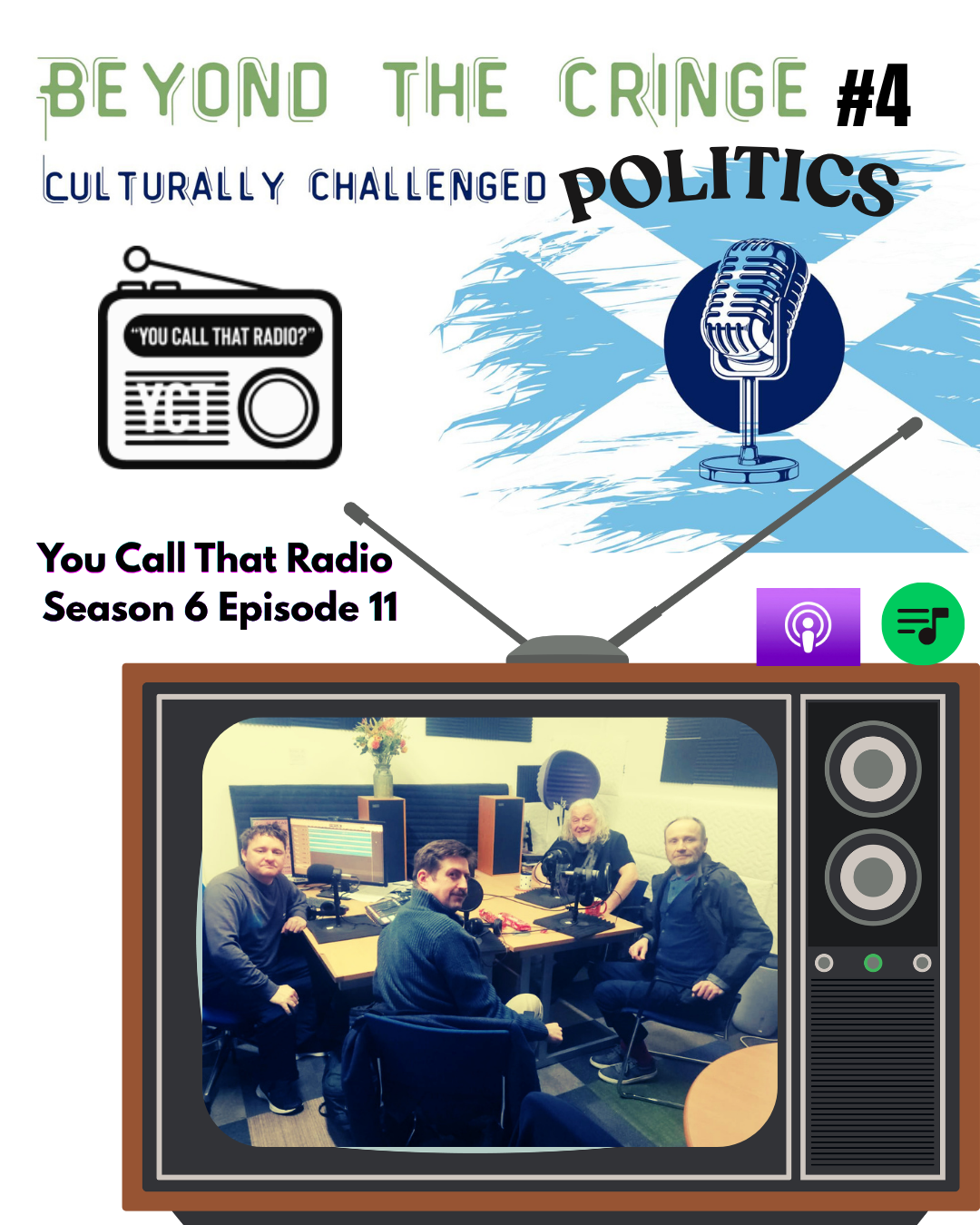
Today we are talking about the politics and with us in the studio, along with myself and Our producer, Mark McGee, we have Frank Rafferty, poet, community arts worker and singer with the Dead Thatchers.
[00:01:18] Speaker C: Aye, if you can call it singing, singing.
[00:01:21] Speaker A: And David Jamieson, who's the co director of Contour, author, historian, etc. And we have. We're hoping to have a chat today about the politics in Scotland.
Now, Scottish politics is a thing I've been involved in for a long time. I'm going to keep my mouth shut as much as possible and hopefully the chat will develop between our two.
[00:01:44] Speaker B: Good luck with that, Jim. Good luck.
[00:01:45] Speaker A: Because I have my own position in Scottish politics, which makes me a target and I enjoy being one sometimes. But with us today, we've got guests who bring together, who bring us a view on Scottish politics. That may not be what you want to hear, but hopefully will be a good chat that you'll all enjoy.
[00:02:06] Speaker C: I hope so.
[00:02:08] Speaker A: I'm going to start with David and just ask the wide question of Scottish politics. If you hear the phrase Scottish politics, what's. What image does that conjure up? What does it say to you? Scottish politics, what is it?
[00:02:22] Speaker D: I think, sadly, the image that comes to mind is probably just the Scottish Parliament building. And I say sadly for two reasons. First of all, it's not attractive, Right. And I think it's. There was a lot of debate about that when it first opened, if you recall, it went over budget, as these projects, I often do.
And then there was a debate about its attractiveness or ugliness. And to be honest, I don't think it's aged very well. It looks like it's got Twiglets Sellotaped on the side of it. And so on. It's an odd looking thing.
[00:02:56] Speaker A: They don't use those things. I mean, I worked here for a while. It's actually a nice place to work.
[00:03:00] Speaker D: Behind the Twiglets, there's little pods, isn't there?
[00:03:02] Speaker A: Yeah, it's little pods that's sitting at the window. It's like a wee alcove kind of thing that you're meant to sit in and reflect.
[00:03:07] Speaker C: Oh, right, okay.
[00:03:08] Speaker A: People just use it as storage. Well, this files and books piled up there, nobody sits in them.
[00:03:13] Speaker D: Well, this is what's interesting about the architecture of the building. So the idea is that you've got these thought pods, right?
And the MSPs, rather than being traditional politicians, they'll be thoughtful. This is all very Scottish turn of the century stuff, right? These are all the ideas that are going around. And the other aspect is rather than in the House of Commons where all the MPs are facing each other and you have the opposition benches versus the government benches, the idea in the Scottish Parliament is that it's like a horseshoe and it's more consensual, everyone's talking in the same direction and so on. Another very Scottish turn of the century type of attitude. What politics is supposed to be for is consensus rather than conflict. Conflict belonging in the 20th century, this was the idea.
The problem with that is it kind of implies that there's no conflict in society, right?
And if you have a consensus in a class based society, you have to ask who is the consensus for, right?
And what we've ended up with via this Parliament with its thought pods and its horseshoe consensual Parliament is basically a consensus around a kind of soft centre left politics, which is nonetheless quite uncomplicatedly pro business and therefore necessarily anti working class. And that's what we've been lumped with. So the second reason I say kind of unfortunately, the Scottish Parliament building is, I don't think that's what we should think of when we think of politics. I don't think we should think of a building where a few hundred elite individuals either sit in pods or think or use them as filing cabinets and sit around discussing their various agreements and minor disagreements about what is essentially a pro business, and not just pro business, but kind of pro status quo in a more global sense, politics. And it's sad that I think in the past, if you thought of Scottish politics, you might have thought of that famous photograph of Jimmy Reeds kind of haranguing his supporters in a shipyard. You know, an image, if you like, of kind of popular democracy.
There are popular democratic movements in Scotland, of course, some of which we'll discuss.
But in general terms, that working class character of politics has obviously declined and we're left with the official status quo apparatus. Sometimes it's gone to not particularly attractive building.
[00:05:58] Speaker C: But I mean, how do you think we would change that? Because, I mean, I'm living in Northern Ireland now and I mean, I look at politics there, which is built on that dhon system and supposedly to achieve consensus by people who've been at one another's throats for generations, and all you end up with is this blandness, which I think is what you're getting at. You know, there's nothing there that's broadly working class or supporting the working class. It's about keep dumbing down, if you like, what politics is about. But I'm also conscious of the fact that within the Northern Ireland system, all over the place you look in politics, being an elected representative has become more and more something.
People go to university, they come at the other end, party researcher, union researcher, with whoever doing a working class job in their lives. Then they end up in politics representing people. But within the Northern Irish system, even, you know, like, say through Sinn Fein, there's a lot of people who didn't go that route, but they end up the same.
You know, they're in the system and they don't seem to be. That's something that's a community anymore that they're there to represent.
It's almost like they get in there and they become attached to the trappings of office rather than being there.
[00:07:30] Speaker A: Well, that's something that's interesting that there was a sort of change probably around that turn of the century where we had. Gradually, through the 20th century, we had this. There was more working class people being represented in politics where people would come through trades and jobs. Yes, mainly through the labor movement that reversed.
[00:07:54] Speaker C: Yes, absolutely.
[00:07:55] Speaker A: To the stage that we are now at.
There's virtually no one involved in politics who hasn't just come through that university into a job in politics or any job in PR and media and then into politics. You don't see the Jimmy Reeds or the even guys like John Prescott and all that. You don't see people who have actually worked in a.
Is that an island, you think that still exists with Sinn because it comes
[00:08:20] Speaker C: from a working class. But I mean, more and more and more of the people that are coming through from Sinn Fein would be people who have graduates, postgraduates, and you know, I mean, even, you know, you go back to the likes of Martin McGinnis a wee while ago, and McGinness wasn't a university educated. Came very much from the bog side.
[00:08:38] Speaker A: Yeah, yeah.
[00:08:39] Speaker C: But even to a sense, when, you know, they become.
[00:08:42] Speaker A: Even.
[00:08:42] Speaker C: Even when they become Deputy First Minister and you're all p. Even a loyalist,
[00:08:47] Speaker A: definitely representatives were working class.
[00:08:50] Speaker C: Some of them were like David Irvine that. But, you know, he died and it kind of reverts to tight.
[00:08:57] Speaker A: It's like, how do you see.
As Scotsman living in Derry, how do you think, like, people in Ireland see Scottish politics?
[00:09:07] Speaker C: Well, I mean, I.
Talking about from where I live, but I mean, I've worked in both communities, have worked in what would be the republican nationalist community predominantly. I've also worked in the other community in Derry in the past.
And I mean, I know if you're talking to most of the people that I would say are nationalist or Republican or that. That they are absolutely gobsmacked by what happened with the referendum, for example, the notion that somebody would have the opportunity to vote for independence for England and. No, take it. But at the same time, you know, I'm conscious that there's a lot of people for the loyalist community who see themselves as somehow connected to Scotland and are quite proud and understand that choice to remain British.
But I mean. I mean, the referendum, for example, I mean. I mean, me and my wife would just get married and we were doing it a wee honeymoon thing at the Highlands and Islands, and everywhere we were going that August 2014, it was like, you know, you could see yes, yes, yes, yes. The week before, there'd been that poll that said yes is ahead, you know, And Rachel, my wife, who's Enniskillen in the north, she was saying, this is amazing.
[00:10:30] Speaker B: Look.
[00:10:30] Speaker C: I mean, people are going to vote yes overwhelmingly. And I was, like, I said, I'm sorry I put a damp blanket on you, Rachel, but I think it's beautiful and it's wonderful to see all this, but I'm not seeing many. No stuff.
Yeah.
[00:10:49] Speaker A: It was a quite magical, let's just
[00:10:51] Speaker C: put it that way.
And to me, the real achievement was where we started, that support for independence and polls and everything, and where it was at the end when it was 45%, you know. Cause that was still a significant claim in that period. It was a huge, you know, and I think that's why they're so bloody terrified about another referendum.
[00:11:15] Speaker A: Do you think that there's been to come back to you, David, this since 2014?
There was. I think it may have been David Torrens there was at least one journalist who talked about Scotland, the kind of Ulsterization of Scottish politics. Do you think there's been this kind of thing where we have moved in a state in Scottish politics where everything's seen through the lens of yes, no nationalist unionists, similar to what's happened in Northern Ireland?
[00:11:42] Speaker D: I think a better comparison, because I agree we're talking about two national contexts here that are both very different and you could draw similarities as well. But like kind of, as we were saying, this is a global development.
[00:11:57] Speaker C: Right.
[00:11:58] Speaker D: Like the tearing up of the working class roots of politics is a global development. Right.
So that, you know, yeah, there isn't.
The kind of working class Republican movement in the north of Ireland has declined. So has the trade union movement. And there's no longer the same kind of umbilical relationship between mass party politics and these sorts of mass civic institutions.
So what I think is really interesting is that after the independence referendum, because you might have thought, okay, here's a mass movement and there was a mass independence movement, perhaps that will infuse some new blood into the party political system. Perhaps we'll see more working class or even just people lower middle class who are outside of the political institutions coming in and infusing some new blood into the situation.
And we really haven't seen that at all.
[00:12:57] Speaker C: Right.
[00:12:58] Speaker D: And part of the reason for that is the existing party political establishment, including the pro independence parties, were very hostile to that. They defended their Taft. They controlled the situation. They didn't want disruptive personalities or disruptive ideas coming in to the political realm. So we're past the point, I think, where this is just an organic development where because powerful working class institutions have declined, they're not producing these new cadres that go into politics. And it's now also like an artificial development where the existing political establishment is deliberately locking working class people out. And when it comes to the polarization, I think you could say in some ways it's redolent of things that happen in Northern Ireland. But I think you could just as easily say it's redolent of things that happen in the United States or UK wide around Brexit, where political polarization is itself a form of management of the mass of the population.
I mean, you look at this stuff in the United States right now not to go off on this too much because it is supposed to be Scotland. And sometimes you do think we discuss internal US Politics too much. Right. It's a bit of a spectacle.
But the fact that you could see in Minneapolis people being murdered on the streets by the state.
Something that I actually do believe. There's been polarization of politics going back for a long time, but I still think 40 or 50 years ago there would have been far more people in the American right saying, I'm against this.
I think that this isn't about politics anymore. It's kind of transcended that into shared moral values. Now the right in America has a tradition of opposing state overreach and state violence in that way. Or at least a rhetorical tradition. Right?
[00:14:49] Speaker A: Yeah, it seems very much. One of the things about Minneapolis specifically is that it seems very much the territory of the traditional right in American politics to be the people who have been offended by and being opposed to us, but they're rallying behind it now.
[00:15:05] Speaker D: They're all in favour of gun control. They're like, why did this man have a gun in the street?
[00:15:08] Speaker A: Yeah.
[00:15:13] Speaker C: Whoever thought they'd see that?
[00:15:15] Speaker D: But the point is that that to me, I look at that and think there's a certain level in which this polarization is like, totally fake and artificial. You're not saying this stuff because you believe it anymore. It's that everyone is policing the barrier between these two political tribes. And it's almost a conscious effort. We need to keep this tribalization going.
And certainly there are people at the top of each of those political pyramids who view politics in those terms.
[00:15:45] Speaker C: Right.
[00:15:46] Speaker D: You simplify politics a lot. You make it more controllable, more manipulable when you keep those sorts of culture war type polarizations alive. And if you think about, I mean, Scotland, something that's happened in Scotland in the last is perhaps in decline. I'm never really sure about that.
But since the pandemic in particular, when everyone got forced into their home and went slightly star crazy, it's become so apparent that the culture war is something you do because of a general feeling of powerlessness that you have in your life.
You can't control the decline of your public services. You can't stop prices rising in the shops. You can't change the fact that the entire world system seems to be tumbling permanently towards war. These are huge things the ordinary people don't have control over. What can I have control over? A sort of magazine argument. Right. That pits me against other people who are also powerless.
[00:16:45] Speaker A: Yeah, right.
[00:16:46] Speaker D: That's crucial. I can pick a fight with you over this or that issue. It's very often mediated through, like, celebrities. It's a very telling item of the government that is so mediated.
[00:16:59] Speaker A: So you can all get behind Jakey Rolling over Cameron.
[00:17:06] Speaker D: And it's so. It's very mediatized. It's like, oh, look what this pop star has said about this hot button issue this week.
[00:17:12] Speaker A: Yeah, right.
[00:17:13] Speaker D: And then, you know, people key into that and it's because they feel that's within my grasp.
[00:17:20] Speaker C: Right, yeah.
[00:17:21] Speaker D: And the. And the traditional areas of politics, war and peace, poverty and wealth, that's way out of my grasp. I can't touch that stuff. And I think that, like, there is a relationship between this polarization and a generalized feeling on the behalf of most people that they've lost control of society, of the political process and so on.
[00:17:44] Speaker C: I mean, how would you think that people who feel maybe on the verge of that, but not completely powerless, push their way back into that political arena? You know, are we actually saying that representative elective politics, isn't it going to work for the mass of people anymore? Or is it just something that's there to keep us dampened down and, you know, raging at one another through social media or whatever? What kind of avenues is there or do we need to build to enable people to participate?
[00:18:21] Speaker A: I think we saw a lot of that in the Brexit link during the Brexit referendum and all that stuff. I think it's quite clear that loads of the areas that voted for Brexit were disenfranchised, left behind communities.
It's well documented, people talk about it all the time.
As to what the answer is, I don't know. But talk about the idea. If you live in Middlesbrough, everybody's telling you about all the great benefits of the eu, Looking around Middlesbrough, thinking, why don't I can see them? You may be equated with the eu.
It's really got nothing to do whether you're in the EU or not. But those are working class communities. They would have traditionally been linked to labor movements, to trade unions in the workplace, where they all work together in the same place, and communities where, if you lived in a town, usually the employer was the main reason for the town existence. So if your dad was in strike, everyone else's dad was in strike and all that stuff, so they lost that and these working class communities in rallying against things that are to their own, to their own benefit.
[00:19:28] Speaker C: Yeah, I mean, I see where you're coming with that. I mean, I'm interested in that. I mean, I used to live in a place called Lee in Lancashire, which was a mining town and heavy industry between Manchester, Bolton and Wigan, and it lost all that even during the period that I was living there and not the last election, but one, two back, you know, Lee voted Tory for the first time in a.
First time ever.
Now, to put it in context, in 1912, one of the places in England where John Maclean would have actually spoke was Lee in Lancashire.
And you got a big crowd.
Okay, 1912 is a long time ago, but in that period, from losing industry gradually post war decline to becoming basically a commuter town between Manchester, Liverpool and other places out there with nothing else really to offer people there. The people who remain there, 30,000 to them or whatever went through being, you know, the saying was, stick a rosette on a pig and put it up as a candidate. Yeah, yeah. You know, they'll still vote Labour and to vote on a Tory for the first time, first time ever, you know, and I mean, it's interesting. And then that was healing all over.
[00:20:56] Speaker A: 2015, on the night of the election, the winner of Labour lost 40 out of 41 seats. I think it was being on the phone to my son, who lived where I'm originally from, Cumnock in Ayrshire. Cumnock was the hometown of James Keir Hardy, which was the num, founded as Ayrshire Miners Federation and all that. Very much a sort of traditional Labour seat. And I remember as Labour were losing seat after seat, my son was on the phone, he was saying, don't get loose. Cumnock, are they? And I was very much a Labour Party activist at the time and I said to myself, no, no, don't worry, we canny lose Cumnock. I think it was Kathy Jamison was the imperial at the time. I said, don't worry, that's not going to happen. Of course it did happen. The SNP won that seat at the next election. It became a Tory seat. And now Cumnock is very much a hotbed of reform. Some of the reform will probably pick up votes and even the seat. And it slipped away. It didn't slip away, it just disappeared. That whole sort of rooted in working class.
The idea, possibly the fault of the Labour Party, but the idea that the Labour movement was where we were rooted was a background of working class just gone, just completely gone.
[00:22:07] Speaker C: I mean, one of the things you mentioned there, Jim, the Brexit thing and places in England and that going for Brexit, falling in line behind Farage and those kind of people, but Scotland didn't. I mean, and that referendum on Brexit, I mean, we still got it, but no, no, not a single constituency in Scotland voted for it. Yeah, but do you think that's sort of changing? I mean, you're talking about the rise possibly of reform and places like Cumnock.
[00:22:40] Speaker D: I think the pattern here is, and I think there is a distinctive and important story here which is like the death of social democracy.
[00:22:48] Speaker A: Right.
[00:22:49] Speaker D: As a movement, as a generational movement. Like I think, you know, after 2014, 15, when people said like, well, this is over for Scottish Labour, that can be taken too literally in the sense that like the Scottish Labour Party could be around forever, right? Yes, but just getting weaker and weaker all the time, right?
[00:23:11] Speaker A: Yeah.
[00:23:11] Speaker D: But what has changed is Irish Labor Party. Well, exactly. Right. Like these, these parties often have a very long tail, right?
[00:23:18] Speaker A: Yeah.
[00:23:19] Speaker D: But it's very hard to completely destroy an institution once it exists. Like the Liberal Party, an iteration of the Liberal Party has existed now, out of power for an extremely long time, except for the coalition government, which was a disaster for them. But it's more that once a person has stopped voting for one of these social democratic parties once, they are never a true Labour voter again type thing.
[00:23:46] Speaker B: Right.
[00:23:46] Speaker D: Their vote is conditional from that point on. They may vote Labour again in the future. So for example, a lot of that will have happened in the last general election. Like Scotland, Scottish Labour had a great general election in 2024.
[00:23:59] Speaker C: Right.
[00:24:01] Speaker D: And yet it's apparent at the next Scottish election that the vote has not recovered. Like fundamentally the basis of the party has not recovered.
[00:24:09] Speaker A: I think they're polling around 15% or something.
[00:24:11] Speaker D: Yes. I mean, in the Scotland that I grew up in, that would have been ridiculous, you know, but then there were still like, I remember my grandparents generation, they remembered the creation of the nhs.
And those are the sorts of political acts that turn people into tribal voters. You know, it's. It becomes almost like a duty to vote labor at that point.
[00:24:34] Speaker C: Because if you remember, if you're talking about people who remember what was before that, then obviously that is the kind of thing that goes, no, that's who I'm voting for.
[00:24:44] Speaker D: Whereas no life, no one 40 or 50 years old or 60 years old remembers this. So Labour simply cannot call on that kind of tribal voting behavior any longer. Unless of course, they wanted to become a kind of transformational social democratic party again, which A, they don't want to and B, I mean, this is the other thing. I mean, people use the word social democracy as though it's just any center leftism.
But there is a level at which, of course, the changes we've seen in recent decades are deep and structural and about world politics.
The NHS was something set up at a time before you had the levels of international financial transactions that you have now, right?
This is what's undermined that model of national democratic politics. And that's, That's a chronic problem. But the one thing to say, because this could all just be gloom and doom, right?
Every democracy is captured by transnational financial changes in the international system. There's nothing you can do. And at a national level, these kind of bougie types have taken over politics and are just pushing everyone else away.
The one thing I would say about that is I don't think that's a stable situation.
And I think we can see it everywhere. Like political systems are in chaos all over the world because of this. Because people feel shut out from democratic decision making, because they feel often deliberately disempowered from the political process.
[00:26:19] Speaker C: Is there a particular time when you would sort of date that from. I mean, because in my head, I remember saying at the time, 2008, with the crashes and everything and make somebody going, oh, that's. People are going to just, you know, fucking renounce capitalism and turn to fucking progressive left movement. And I'm always been a bit. Yeah, I don't know. Cassandra is no, the right word, but a doomsayer anyway.
I was like, no, about 20 years before that happens. You know, they'll stagger on with this neoliberal pish for another couple of fucking decades and probably get away with it. But I mean, I do actually think it's coming. Yeah, to an end. Yeah, but it's like that. I mean, when I'm saying, how do we get people engaged with a positive politics? It's like, because my fear is if we don't have that offering there visible and in the face of people, when this really becomes apparent, what's starting to happen, then they will turn, I think, for the populist and, you know, the fascist trickster that happens to be around the corner spouting shite about their neighbors, you know, and that's my fear. I mean, I don't know where the progressive offering is. I see a lot of things positive. You know, I see action on the street over Palestine a couple of years ago. I was never as proud to be for this city in my life as when they fucking chased those home office immigration ones away.
[00:27:55] Speaker B: Jim was right in the middle of that.
[00:27:56] Speaker C: Yeah. And I mean, honestly, watching that for I was just like, this, to me, is politics. This is what it should be about. How do you get it happening at community level where you just reject the offering and you build something and how do you.
[00:28:14] Speaker B: How do you. Why are people always likely to fall for the fact that someone like Nigel Farage has got their interests at heart. And why are people falling for that?
[00:28:25] Speaker A: Again, I think to come back to something I mentioned earlier about, you know, the workplace been central to why a community that exists.
[00:28:33] Speaker C: Oh, yeah.
[00:28:34] Speaker A: But when I grew up, and I don't want to be too, like, romantic about all this, When I grew up and I was born and bred in a place called.
Most of my school years, a place called Golson.
In Golson, we had a co op.
[00:28:47] Speaker C: Yes.
[00:28:47] Speaker A: Now, not Scotland or any national, actual local corps.
[00:28:51] Speaker C: Yes.
[00:28:52] Speaker A: They had a shoe shop and a pharmacy and the funeral directors and a drapery and three, like, corner shop type things. It was a big employer, but we all owned it. Every three months you got what they called the divvy. That was your share of the profits. And in actual cash, not in a loyalty card and all that stuff.
We had trade unions, different world. We had a labor club, we had churches that were active in communities and all that. All of that stuff disappeared.
To recreate that in today's society is very, very difficult. Places like this at Govern bas.
[00:29:24] Speaker C: That's what I was going to say
[00:29:25] Speaker A: when we get people out of the house and come to meet each other and talk was very big driver behind what happened at CHEMC in.
Because you have networks of people who. Not necessarily politically active, but knew each other through simple things like. Yes, knitting clubs and chess clubs and things like that. You know, actual community things where people come together that it kind of needs recreated, but it won't be recreated in a.
In a political way. Before, it wouldn't be rooted in the trade union movement.
[00:29:59] Speaker C: Yes.
[00:30:00] Speaker A: Or the court movement.
[00:30:01] Speaker C: No, I mean, I get what you're saying, you know, a community level. I mean, where I'm from. I mean, one of the things I do recall is one of the reasons where I'm from, where Sinn Fein became as powerful politically as they have is because they were very good at grassroots community work. You know, they set up advice centers. They still do that to an extent, the advice centers and all that. And the community centres. A lot of them are there and a lot of them might be under the control of one party or another, which is not ideal, let's be honest.
[00:30:35] Speaker A: I mean, they came out of a revolutionary, an armed revolutionary movement. Well, just. Just 50 years ago.
50, 60 years ago.
[00:30:43] Speaker C: Well, you know, I mean, there's a lot.
I mean, there's a lot of people I know who would be, you know, probably seen as dissident or just socialists or whatever, who would say that. Yeah. Definitely armed. But you know, the revolutionary bit was probably for a lot, for quite a few of them, a bit of kidology really. It suited.
[00:31:04] Speaker A: Quickly moved here.
[00:31:05] Speaker C: It doesn't, it doesn't take away that they were very effective at grassroots politics. People in communities knew that they were on their side and for them and that paid dividends electorally.
And I mean one of the things I wanted to come to as I remember when the Scottish Parliament gets set up and through the list system there was some people for the Scottish socialists got elected. Not that many of them, but six, but there was some. And I remember seeing that some of them were setting up we advice centers through the expenses and the money that they were getting. And I was wondering about. Because I wasn't here. But then it's like, were they effective?
[00:31:48] Speaker A: I think it came the other way around, Francis. I think that quite a lot of the. The rise of the SSP was rooted in working in.
[00:31:55] Speaker C: Yes, that's.
[00:31:56] Speaker A: And I think that quickly disappeared when they got any Parliament. You see it with sinn. I mean there's. There's jokes about the old g. Revolutionary songs, but instead of men behind the wire, it's now the men behind the desk and you know, the brilliant.
[00:32:08] Speaker C: You know. And a while back it was like chocky and la. Because
[00:32:13] Speaker A: the broad black briefcase and. And so there was a very, very quick turnover. I was involved with SSP at the time.
[00:32:20] Speaker C: Yes.
[00:32:21] Speaker A: Very, very quick move to that being a parliamentary party.
[00:32:24] Speaker C: Okay.
[00:32:25] Speaker A: And it was very much a community based party in places like Pollock and things like that. But very, very quickly, when they became part of the. The political system, they embraced the political system and became part of it. So as an activist in the ssp, you went from being encouraged to being getting involved in everything in your local community.
[00:32:48] Speaker C: Yes.
[00:32:48] Speaker A: To being encouraged to get behind a petition for a bill in Parliament. Yes, behind one. Behind the. We went from being the sort of cult of celebrity of one politician to the cult of celebrity of six politicians that we had to get behind the other.
[00:33:02] Speaker C: See, I mean, I wonder about that because within Northern Ireland. Well, within Ireland as a whole now, there's one of the things that's emerged on the left as people before profit.
[00:33:11] Speaker A: Yeah.
[00:33:12] Speaker C: And they're trying to be effective at community level and they're trying their best.
But I mean, I remember a few years ago Eamon McCann, who. I know Eamon get elected to Storm and.
And the following electoral cycle they reduced the amount of MLAs there was to be sent to Stormont. So instead of six going Federia, there was only five. So Eamon didn't get returned in that one. And to be honest, I've never seen a man so happy.
It's right to hide it inside. He was delighted because he thought, what else could I be doing with my time that would actually be productive than being sat in this chair?
[00:33:57] Speaker A: A very good example. Amy McCann was always involved in class politics.
[00:34:00] Speaker C: Yes.
[00:34:01] Speaker A: From. From even way back at Bloody Sunday.
She was very active in his.
[00:34:06] Speaker C: Well, you know, which is this week,
[00:34:07] Speaker A: always, you know, that.
That sort of sectarian divide.
[00:34:13] Speaker C: Absolutely, totally.
[00:34:15] Speaker A: Do we have that in Scotland right now?
Is there a movement based in class politics anywhere in Scotland right now?
[00:34:22] Speaker D: I mean, it depends what you mean by class politics. And I think that there's good reason to understand that phrase somewhat more broadly than it's sometimes used. Right, so like, for me, like the recent Gaza movement, right, is it a class movement in the sense that it involves working class people organizing at the point of production or organizing a rent strike or something like that? No.
But does that mean. And this is sometimes how it's portrayed on the right is it's kind of like the militant wing of Oxfam, you know, when it's people just, oh, you know, people are suffering, I have to be a savior or whatever. I don't think that's true either. I think there is a class dimension which is quite straightforward and it's the same class dimension that has powered one of the big things that's happened in the British left and the Scottish left in recent decades. And unusually, the British left is in the vanguard of it at a European level. In many countries, there are lots of things the left does much better than this country. But the thing that's been done well here is the anti war movement and it undoubtedly has a class angle, if you even think back to Iraq. I mean, the first demonstrations I went on in Glasgow were in Iraq and I was acutely aware of the fact. And in those days, SSP speakers and others on the left were quite good at linking these issues together. Everyone was aware that, absolutely, yes, it was about Iraq, but it was also about other things.
[00:36:03] Speaker C: Right.
[00:36:03] Speaker D: It was about the alienation that working class people felt from New Labour.
It was about a general feeling that in the Thatcher period, in the immediate post Thatcher period, there were big winners in British society who'd made a lot of money and it wasn't working class people.
And when I went on those early demonstrations, like the turnout, you know, yes, of course, there were students and there were activists and there were people from the kind of Public sector, trade unions and so on. But there were a notable large number of people as well from like the East End and the north of Glasgow. You could tell that there was a meaningful class, like working class composition in those demonstrations. And it expresses the alienation that people are aware of, that they are not in control of state policy, they're not in control of these big decisions that are being made in society about the allocation of resources, about the direction of society and so on. I mean, speaking about the SSP there, it's about the practice of the, of political actors, but it's also about the context. I mean, my view is that the SSP and I wasn't really involved in the ssp, I was involved in the anti war movement, but not. I was living in Ayre. I was, I don't know, 14 years old or something. So I wasn't really involved in the ssp. But my impression was they benefited from their leadership in the anti war movement as well. So it wasn't just about that. They had a kind of local appeal in communities at a national level. They were seen to represent something like a political mood and so on. The story we tell ourselves about the SSP is that it collapsed because of the ill behavior of actors at the top of the party.
And I'm sure people divide over who the true bad actors were or whatever. The only thing I want to say about that is I think it would have had problems anyway. I just think it would have. And look, I mean, what are we imagining? That the left is in crisis all over the world, but it wouldn't have been in Scotland.
The problems we are discussing here, how do you balance a political strategy, like a parliamentary strategy with a community strategy, with a national extra parliamentary political strategy?
They are constant serious problems and they're aggravated by the fact that the traditional institutions of the working class are weak.
It may have been the case that if you'd had a party like the SSP alongside a strong trade union movement with a strong, say, working class rank and file in that trade union movement, once those MSPs had gone into the Parliament, they would have felt under pressure not to get sucked into the machine, not to get sucked into that kind of media political cycle or whatever, right? And I don't say that even as a criticism of the MSPs like those, like this is something that happens over and over again. Those structural pressures are real. There's a cost that comes with refusing to play the parliamentary game, right? You might lose your seat.
Tell me if I'm wrong.
[00:39:10] Speaker C: Here.
[00:39:10] Speaker D: But one of the things that hurt Eamonn McCann was he refused. And it was a very hard and difficult position to take. But he basically took a principled position on the Russian invasion of Ukraine. Right. That comes with a cost. Like when you say I am against.
I don't remember exactly the position he took, but it was basically, it wasn't. It wasn't the position that many on the center left took, which is like, let's dive into this with two feet. With two feet, right, and start throwing bombs into this situation. Arm the Ukrainians and fight to the last and so on. He was sort of like, no, we should oppose this war and so on. Hard position to take and one that will cost you. And if you start thinking in an entirely parliamentary mode about politics, you will be forced into a lot of retreats, a lot of conservative behavior, a lot of think about the next election cycle and so on. But if you're going to pursue like a very principled politics, you need to have a counterweight outside the parliament that's holding you to that position.
[00:40:15] Speaker A: So does it come back to that thing way back at the start you said about the parliament being about a consensus.
So if you're not taking part in that.
Yeah, yeah, yeah.
[00:40:23] Speaker D: If I don't want to be part
[00:40:24] Speaker C: of that, there's an electoral price, you know, if you're saying things that are outside of that consensus. Absolutely. Then it's shaped so that you will suffer electorally, you know. And yeah, that would certainly be one thing. But to me, the thing that was used to me, people before profit, because they were newish and they were sort of rising, not hugely popular, but they were getting somewhere. To me, the biggest mistake they made, again, there was a consensus or was there was over the Brexit thing.
[00:40:55] Speaker D: Oh, it was that.
[00:40:56] Speaker C: Was it more than that when they were part of Left Exit?
[00:41:01] Speaker D: That's what. No, that's it.
[00:41:02] Speaker A: Yes.
[00:41:04] Speaker C: And I mean, at that point I left. I joined people before profit in as much as you could join. You weren't actually given a card as such, you know, but it was. Which I always thought you should have a wee membership card. But some people were against that having come over.
And basically I was, I was the treasurer for the North.
But when it came to the Lexit thing, I mean I was.
It's not that. I mean the Greek thing was going on at the time as well and it was a last minute thing for me. I was wearing it up in my mind about yes, no, yes, no. Overall, Europe has been a positive thing
[00:41:51] Speaker D: for People in Ireland, that's what I was misremembering.
[00:41:54] Speaker C: So I mean, I, But I mean, I know for a fact that ever since they went for Leave Europe, you know, left exit, that that's been a stick every election getting banged over their heads, you know.
[00:42:09] Speaker D: But that's the cost of like for Eamonn. That's a principled position.
[00:42:13] Speaker C: Oh, totally.
[00:42:14] Speaker D: They will definitely have lost.
[00:42:15] Speaker C: I mean, I know you're saying Eamon there now, I mean, the people for profit line was a left exit from Europe.
Eamonn personally didn't give a fuck one way or the other. You know, it's like he said, you know, stay in Europe, leave Europe. I don't think it's going to make
[00:42:34] Speaker A: any huge difference to Scotland. Scotland tends to have.
We tend to have this image of ourselves being more left wing than England or more left wing or is it more social democratic, whatever. Do you think there's any truth in that?
Is there a. Do we kid ourselves on in Scotland?
[00:42:55] Speaker C: I don't know. I mean, looking at it the outside, but being back fairly regularly and I think aware of Scottish politics, I think there's an element of truth. Yeah.
I don't know whether it's. Maybe we're not so easily gulled by right wing media and talking points, although
[00:43:18] Speaker B: social media seems to be changing that a little bit. Possibly because we're talking earlier on about the. All those community grassroots things and governor's place to have this for that. But it's decimated across the country. So when you, when you take, if you have the community and you take away austerity, where are people going? They're going into phones and they're seeing some ridiculous misinformation all the time. And yeah, somebody's always trying to sell them something.
[00:43:45] Speaker A: You're swamped by misinformation.
[00:43:46] Speaker B: And also, you know, I found that interesting. You were saying earlier on about, with a politician, about actually going with your gut rather than going with the party is always a problem as well.
[00:43:55] Speaker C: Yes.
[00:43:55] Speaker B: And then the Billy Connelly, the fact they should want to be a politician should ban you from being a politician.
[00:44:00] Speaker C: Well, I, you know, you know, what's
[00:44:02] Speaker B: this Scandinavian country that did something similar where it's like you're not allowed to. You're not allowed to be a politician for a year or something like that to get people.
[00:44:09] Speaker C: Well, I mean, I think ICELAND, after the 2008 crash did a lot of things. They formed a thing called the People's Party or the Party Party and you know, they were the only ones who said, you know, fuck off, you're not getting your debt repaid.
Him and pointed at bankers and politicians. They're responsible, they're going to jail.
[00:44:29] Speaker B: Yeah.
[00:44:30] Speaker A: Does anybody.
[00:44:31] Speaker B: Does anyone have any suggestions on how to stop the career politicians? Because I think that's a really good point that you make, that people are thinking about the next election cycle because they've got a job with status, power, money. And I'm sure not all. I'm sure not all of them are evil, but they're just sort of. They've got themselves in their career lad, and they're just saying, well, I'm a good person, so I'm. For me, I need to. I need to go with this so that I can stay in, so that I can do more good work. And they kid themselves on. And then obviously, essentially it's the.
[00:45:00] Speaker A: Instead of changing the system, it's a
[00:45:01] Speaker C: systemic change in the job. I think it shouldn't be a permanent job.
[00:45:06] Speaker B: So what do you think? Can we just.
[00:45:08] Speaker A: Well, isn't he a permanent job in a way that you're.
[00:45:10] Speaker C: Oh, no, you're up for election. But, I mean, some seats, it seems to be.
[00:45:14] Speaker A: And there are people, obviously, stay in the job for a long, long time, build up a kind of popularity.
With Jeremy Corbyn being an example. He's been here or something in the same seat and even stands an independent.
[00:45:26] Speaker C: Yes.
[00:45:27] Speaker A: Which is a very difficult day. And so you can have it as a permanent job, but it's quite a precarious job for a lot of people.
[00:45:34] Speaker C: No, there.
[00:45:34] Speaker A: When we had these snap elections here, there was, let's say, Paul Sweeney in Glasgow, who went through sort of being a guy in a normal job, giving us 80 grand a year salary in Parliament. Two years later, he's back out and he's on the brew.
[00:45:48] Speaker C: Yes.
[00:45:48] Speaker A: And within months he's in poverty. You know, I mean, it's a very precarious job.
[00:45:54] Speaker D: There is a problem.
[00:45:54] Speaker C: Well, I mean, I know the 2015 election, a lot of them learned how precarious it was, but being precarious is
[00:45:59] Speaker B: not a problem because they're. Look, that's why so many politicians are out there, get as much. Get as much as they can, because they know that here I don't have another year or two. So they're just doing.
[00:46:10] Speaker D: I mean, the reason that this, like, this way of controlling politics, as it were, is so ironclad, though, is that there's layers to this. So, I mean, I'm going to get back to the question of, like, Scotland and its supposed Progressiveness. But like, I mean, I sometimes think to myself, see, if Keir Starmer wanted to be like a left social Democrat, could he do it right?
Let's say he was like, he just two fingers up to Trump, do one. I'm not going along with whatever it is, Greenland, Venezuela, I'm not going along with it. He's like, I'm going to shove tons of money into public services.
We're going to nationalize some of the top utilities like water and stuff that doesn't work.
What does that actually look like?
Does the society just become social democratic at that point? And obviously the answer is no.
The UK just comes, comes under tremendous pressure from various angles from the United States and its allies. It's in trouble with its European allies at that point.
It's in trouble with the money markets, it's in trouble with the bank of England and it just spirals out of control. I mean, you look at British society today, we're talking about misinformation, but something that's going on and we're about to, it's about to crash into us here in Scotland is the US elements around Trump, Elon Musk and so on. They're actively stoking political movements as pressure movements inside British society.
[00:47:39] Speaker C: Right.
[00:47:40] Speaker D: So we're being subverted in that sense.
[00:47:44] Speaker C: Right.
[00:47:45] Speaker D: And that would become even more intense if you had a meaningful left wing politics. So there's a behind the problem of careerism. Like all these careerists in some level, like they're being quite practical, they're being quite rational. If I broke from the consensus, if I broke from this career pattern, what do I come up against? An absolutely horrendous attack from people much, much more powerful than me that would sink the country into chaos. Right. So there's a rationale to how all this stuff works. And I just think, I mean the type of conversation we're having here today, it would never occur to people in the Scottish Parliament, like to them, what we are talking about when we talk about politics is a fantasy. It doesn't exist. All there is, is the career based administration of a pot of money that comes from London and that's it.
There's no horizon beyond that. The horizon beyond that exists for, may exist for some ordinary people or for ordinary people, they also collapse into kind of.
No, that's the horizon that's set by these people in charge and there's no moving beyond it. I mean, is that different in Scotland than in England?
There are some different dynamics. There's no doubting the fact for Example that in recent decades, the debate about immigration is different in England and in Scotland. How much is that to do with the fact that Scotland has like, specific problems with population growth? Right. How much of it to do with the fact that the developed institutions don't control our border policy?
I don't know the answer to that question. It's very, it's very difficult to know how much of it is. There are kind of deeper cultural thing. I'm a bit suspicious of that. I feel like one of the things this election will probably show is that, I mean, it was only 10 years ago everyone was saying UKIP, that's purely an English phenomenon. Right. And we still elected a UKIP mep. And now, I mean, Brexit is obviously the successor party to ukip and there's a real possibility that they're going to be the second party in Scotland.
So I'm skeptical, to be honest. At the same time, it's too easy. And sometimes, if you recall, during the referendum, there was this kind of labor line of like, oh, you think you're so special in Scotland and all this kind of stuff. There are cultural differences. There are cultural and structural differences to do with the nature and makeup of the society, but I don't think they're fundamental and I don't think that there's a reason to think they won't change.
[00:50:24] Speaker C: I mean, given what you've said there. Is there a way? Okay, imperfect as it is, say the electoral politics as it's set up here with the list system and that, what's the most effective way to prevent reform getting a foothold if they're going to replace the Tories and Labour as the natural place for a unionist vote to go, despite other racist shit.
[00:50:49] Speaker B: Yes.
[00:50:52] Speaker C: I mean, it's like there must be some way of encouraging people to vote tactically to try and keep that to a bare minimum.
[00:51:02] Speaker B: Jim, you should probably take that there's
[00:51:06] Speaker A: a care of it that's a special subject. I mean, that's a perennial like dilemma and creation. And almost every attempt to do that is to say that we can. Here's a way we can all work together to prevent this happening.
Rather than being a proactive thing, that here's a way we all work together to get this happening, some sort of proper transformation of society. If it's about stopping something else, then what you have is a lot of the groups who would naturally you'd see to come together in that have their own self interest.
And so it's very, very difficult to put together because the five or six political groups that you put together to do that.
[00:51:47] Speaker C: Yes.
[00:51:47] Speaker A: Will all have a different idea of how to do it. And to them, and I don't. I'm not going to go at any particular group here, but to them, their strategy is by far more important than anything else. Than anything else, it's probably even more important than stop.
[00:52:04] Speaker C: I mean, that's what I mean. I mean, I'm caught conscious that, you know, for the snp, for example, coming into the election in me, it'll be like, you know, vote SNP 1 and 2, you know, make sure they get the most list.
Because, I mean, I look at the system, the Dahant system in Northern Ireland, and I look at them up, you know, the PR system that we have there. And I'm, you know, I'm sick of going to elections, Aaron, you know, and if you're voting for Sinn Fein or the SDLP or whatever, you know, it's just like, vote 1, 2, 3, 4, sin fear or 1, 2, 3 sdlp and ignore all the other people rather than actually thinking strategically, you know, as a block, and think, well, if I vote him for one.
[00:52:47] Speaker A: And it's very difficult to persuade any political party to do something that isn't directly benefiting men. Benefit, yeah.
[00:52:58] Speaker B: Why do you think Faraj and Boris were successful in doing that little deal?
That was the Corbyn election, wasn't it?
[00:53:04] Speaker C: Where they stood down and, oh, he stood down in all Tory seats.
[00:53:08] Speaker B: Yeah.
[00:53:08] Speaker A: So, I mean, I don't know if there was an actual particular deal there, but I think people make mistakes sometimes of thinking that the right are better at doing these things in the left. The right don't have an organization and don't need to have an organization. They just need to have a narrative and a rhetoric that tells a certain story that divides people and causes a bit of chaos and whatever. I mean, we saw UKIP winning a European election here in Britain, and before that, I think the one before that, the BNP had taken over a million votes straight after Ukip won one, Brexit won. Brexit party formed like 10 minutes before the election and won again. They don't need to be particularly well organized. They just need to have a story and a narrative. And the left and social democratic parties are more fixed towards one particular organization or party that you're a member of. And so, I don't know, it's like
[00:54:05] Speaker D: in Scotland, you got this thing where people endlessly, like, say to the snp, why don't you promote our party on the list? And so on it's like, why wouldn't.
[00:54:13] Speaker A: Yeah, why would you get that?
[00:54:16] Speaker C: But, you know, but I mean, if. I mean, you know, we're saying there about the right particular story to tell, so they don't need to.
[00:54:23] Speaker A: Yeah, yeah.
[00:54:24] Speaker C: But I mean, if the story to tell is, you know, how do you get an overwhelming majority of parties for independence at Hollywood at the election in May, then surely the story is about how do we maximize that using the list.
[00:54:39] Speaker A: But I think. I think the differences between the right and the left parties is what the right want to do is just cause a bit of chaos so that the people that make money can make me a money that. That's. So they tell a story about whether it's immigration, whether it's about trans people or whatever.
Yes, they're not really actually interested in those things. Don't really care. They don't care. They would take a billion more immigrants tomorrow if it benefited them financially. But they'll tell a different story in public because what they want is the chaos that allows money to be made. Whereas the left, or the sort of progressive, sort of center left towards the left have an actual plan, have an actual agenda to a certain extent, which they won't put into place because the system is against them doing it. Yes, but they believe in that thing. They think they believe in this actual thing that's leading to an actual outcome.
The right don't need that outcome. The outcome they need is chaos that allows the people to make money, to make more money.
[00:55:41] Speaker D: And the problem with anti reformism as a political motivation is that it becomes a trap, right, so that the left becomes the people who are saying, keep the status quo.
[00:55:52] Speaker C: Yeah.
[00:55:52] Speaker D: You know, this is. This is the problem. It's sort of like, I mean, if you just. I mean, where we are in the south side of Glasgow at the moment, right, it is the case that the NHS is a mess, like people. And at such a kind of level that people can't just keep ignoring it, you know, forever. They just. They can't. The public services are a mess, you know, the prices, like the way, by the way, that the cost of living crisis is misunderstood in the media is just unbelievable. Like, I hear people all the time in the press saying prices are falling. Prices are absolutely not falling.
[00:56:29] Speaker A: No, they're just rising.
[00:56:30] Speaker D: They're rising more slowly.
[00:56:31] Speaker A: Right.
And they didn't ever come back from that high increase.
Now it's just rising slowly.
[00:56:37] Speaker D: Yeah.
[00:56:38] Speaker A: You know, everywhere you go, every shopper
[00:56:41] Speaker D: in the 75% of the population who are earning within the range of normal incomes or whatever. Every single one of them who goes into a supermarket is shocked by the prices every single time they see, right?
So, like, people feel like they're in a vice, right, with these things, crumbling services, rising prices and they're getting squeezed in the middle. And see, the thing, something you said earlier about, like, why are people being fooled by Farage? I've spoken to quite a lot of people who intend to vote reform in England and in Scotland, and the thing that I find is they know. I was having a conversation with a guy in Queens park, just down the road from here, about why he's voting for reform. The other day, and he was a builder, self employed, and I was talking to him and he knows that Faraj is a chancellor. That's how he described him to me. He's like, oh, he's a Tory, he's a scumbag, right? And I was like, so why are you voting for him? And he's like, look, all these other parties, Labour, SNP, Tory, they've all screwed me, right? I know 100% that they are going to screw me again, but maybe with reform, it's only a 95% chance I'm going to get screwed. I'm not joking.
[00:58:03] Speaker B: And that's the Trump effect as well, where people say that at least it's all right for Trump to steal millions and billions, because
[00:58:14] Speaker A: I know the EU screwed me, so I might as well
[00:58:17] Speaker B: vote for Bernie Sanders having a big hus or whatever. Bernie Sanders got a big hoose.
[00:58:23] Speaker C: I mean, it's terrifying at that point.
[00:58:25] Speaker D: The level, if all you've got is a Hail Mary, a Hail Mary is good.
[00:58:29] Speaker C: I mean, that's not even a Hail Mary, that's a hail.
[00:58:34] Speaker B: Before we're nearly time for Jim to have his final thoughts and his last question, but just a question that I'm always quite curious about is hypothetically speaking, what would the world be better with any political parties?
[00:58:50] Speaker A: It can happen, Mark, because what, what, what would immediately if all political parties disappeared overnight, okay, and you started from scratch with a blank slate tomorrow.
[00:58:59] Speaker B: Scottish independence rate. Okay, so Scottish independence, then people start,
[00:59:03] Speaker A: people with a shared interest will think to come together to promote that shared interest.
They will automatically gradually become parties. That, that's, that's how it works. You know, you can't have 50 million individuals having 50 million manifestos.
You can't possibly do it because all.
[00:59:28] Speaker B: It's a more local thing in Scotland
[00:59:30] Speaker A: was 129 independent MPs, MSPs. Then what they would have to do and to Enable to get things done. They would have to start grouping up together as the group of MSPs that support that bill or that bill.
[00:59:45] Speaker B: It would be on a bill by bill basis though, rather than.
[00:59:47] Speaker A: It wouldn't be. It would.
[00:59:48] Speaker B: Rather than voting for your pal.
[00:59:49] Speaker C: It wouldn't be depend on the common interest.
[00:59:53] Speaker A: They would end up being in a group that promotes a shared group of policies and it would end up being the same thing as a party, I think.
[01:00:00] Speaker C: You know, I mean, I remember before the last referendum reading something, not sure if it was in the official document that they put out, but a notion of after independence having 100 separate councils within Scotland.
And I read that and I thought that would be good if as much power as possible was transferred to those councils post independence, because then they could decide what powers are going to reside with a centralized parliament and the local
[01:00:39] Speaker B: people should have a better idea.
[01:00:41] Speaker C: Has evolved down to something like 100 councils in an area the size of Scotland.
But they evolved from where I think it increases and is beneficial to that kind of democracy and possibly without the necessity of everybody being involved.
[01:01:02] Speaker A: But devolve from where, Frank? And who decides?
Who decides which council gets what more pot of money, etc. Etc.
[01:01:09] Speaker C: No, I know, I know.
[01:01:10] Speaker B: You'll decide. You'll be the king. You make you a king.
You just divide it up fairly among the councils, let the local people decide.
[01:01:18] Speaker A: But for what they need the we needs to form a consensus and that will.
[01:01:24] Speaker B: I'm saying, hypothetically.
[01:01:26] Speaker A: Hypothetically, yeah, that's what I'm saying. Hypothetically it would end up being the same thing.
[01:01:32] Speaker D: You can be a victim of the evolution, of course. I mean I would say that we in Scotland are victims, victims of local devolution. Because look, what we have is we get a pot of money from London. I know, of course we have some tax raising powers. Loath though various parties are to use them.
And then the debate becomes, well, how do we divide up this money? And what you end up with is that kind of polarization again, where SNP supporters say all the problem with Scottish services is about how much money we're getting from London.
And pro union people say all the problem is how it's being spent in Edinburgh. And what that ultimately means, of course is all the politicians are off the hook. That's the outcome of that situation.
[01:02:16] Speaker B: It's such a boring thing.
[01:02:17] Speaker D: No one's responsible anymore for how the money is raised or how it's spent or whatever. Like devolution has been a powerful tool during neoliberalism for the. You know, there was a late Scottish historian called Neil Davidson who called it devolving the axe. Basically what you're doing is you're creating a network of institutions, none of whom have ultimate responsibility for cutting public services.
[01:02:42] Speaker A: And the council can blame it on the Scottish Parliament. The money, it's coming down and then, and then, and then even within councils, what they do is they form arm's length organisations. Glasgow, we no longer have council housing, we have housing associations.
[01:02:55] Speaker C: No, I know.
[01:02:56] Speaker A: And so you go to your local MSP or your councillor about the state of your housing, they could say, I agree with you, I'll write a strongly worded letter to the Housing Association.
Who do you hold responsible? So what's your vote? Is your vote worth anything if you can't actually hold the person responsible to account at an election because none of them are to blame?
[01:03:15] Speaker C: Well, yeah, you know, whether it's the state of health services or housing or.
[01:03:20] Speaker A: Yeah, according to them, they're not to blame. It's someone else.
[01:03:23] Speaker C: But
[01:03:26] Speaker A: is that all right? Okay, well, well, I, I, we're coming towards the end, actually. I think I'm going to ask a final question here. It's a very, very difficult question to kind of put all of these thoughts into one particular idea. So, so I'm going to ask, I'll ask you first, Frank.
[01:03:44] Speaker C: Yes.
[01:03:44] Speaker A: We wake up tomorrow and Frank Rafferty is now the first minister for a day and gets to implement any policy, any policy, any policy you can to change Scotland.
[01:03:56] Speaker C: Okay. It might not seem too radical, but it's like as long as I have been conscious of its existence, the one thing that I wanted removed from Scotland with all my heart was fast lane nuclear weapons. I want them gone.
I think that would transform Scotland in a hell of a lot of ways. It might bring the wrath of our so called allies down in our heads for a while. I think ultimately people would actually start to feel a bit freer and less of a target.
And I mean, I find it terrifying, you know, the notion that that's there, you know, I'm talking to somebody who years ago would have went and stayed in a caravan up there and, you know, have been on mad protests up there. Remember one night being there when they were bringing in cruise missiles and people, everybody encouraging people because we thought they were coming in this back lane and it was very, very cold. So people started sliding up and down the road and there was people looking, look at them, daft ages. But it was quite effective.
They had to change the route because it was a sheet of ice.
[01:05:13] Speaker A: That's a good one. But I mean isn't that kind of. I don't know, that kind of disappeared? I remember just, I mean relatively recently going up every year. What they called the big blockade shut down Fazlane for a day and there was a certain amount of consensus for the cops that you could get arrested if you wanted to and all that stuff. But there's nothing in that scale about the nuclear weapons in Scotland anymore. It's kind of fell away. How you better.
[01:05:37] Speaker C: No, I know, but I mean at the same time fast. What would I do?
[01:05:41] Speaker A: Especially with the Greenland. Especially with the Greenland thing.
[01:05:44] Speaker C: Yes.
[01:05:45] Speaker A: You can imagine if we try to get rid of Trident with Trump then, or any American then say oh sorry but Fazlain is now part of America. You know what I mean?
[01:05:55] Speaker C: Well, I know that's a good one. It kinda isn't he part of Scotland anyway.
[01:06:00] Speaker A: Yeah, absolutely. David, what would your one policy be?
[01:06:03] Speaker D: Well, that was a good one. Tried and I mean can I breach the powers of the First Minister? Because that's part of the problem here. Like the First Minister doesn't actually have a lot of power to do good stuff. Okay. It's a fantasy First Minister. Let's, you know, even in an independent country or whatever, the thing I would do, not to be pious but like the thing I would do would be to scrap all anti union legislation and all the kind of accumulating controls on protests such as the prescription of Palestine action that we've seen thousands of people arrested over in recent, in recent months.
[01:06:40] Speaker C: Does that count as one?
[01:06:42] Speaker D: Well,
[01:06:44] Speaker C: because I've got other suggestions.
[01:06:46] Speaker D: I'm First Minister.
I say it's one because I think
[01:06:51] Speaker A: like if I don't know, I would do a whole manifesto, it's all said
[01:06:55] Speaker B: in one sentence, one breath.
[01:06:57] Speaker D: Because I think like the ultimate solutions to what were all the problems we've identified here is popular power. Right? I mean I know that sounds like it's kind of an easy way to park the conversation, but it's not going to come from within the system.
So that means it's coming from outside. And weak though those popular powers and institutions might be in our own lifetimes, I think they can't stay that way. I think that the nature of changes in the world system mean that there will be a repoliticization.
[01:07:32] Speaker A: That's great guys, thank you so much. Over a really interesting conversation again.
I'm glad I got you both together here.
[01:07:38] Speaker C: Thank you.
[01:07:38] Speaker A: To talk about all things really enjoyable, the politics and I hope you all enjoyed listening in this is beyond the cringe and thanks to Frank Rafferty, to David Jamieson, to Richard Bull, from Glad Radio to my producer, Mark. And that was Sinjamuran and me, of course, as well.
Thanks. Been beyond the cringe, thanks to the deep end.
[01:08:00] Speaker B: Bye.
You are tuned into yct,
[01:08:08] Speaker A: powered by
[01:08:08] Speaker B: our Patreons at patreon. Com.
You call that radio.